
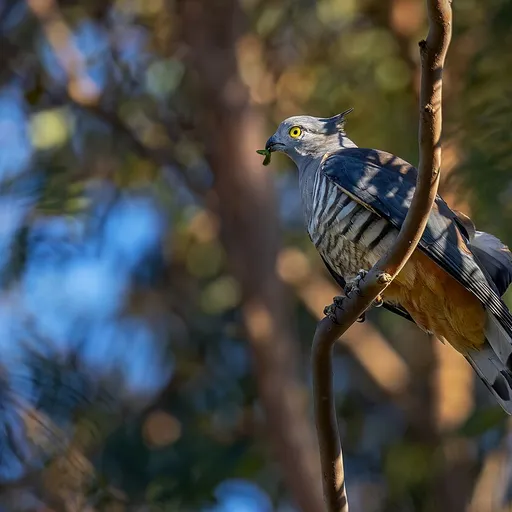
Pacific Baza
Aviceda subcristata
Least Concern
Overview
The Pacific baza (Aviceda subcristata) is a slender, medium-sized hawk found in the Australasian realm, also known as the crested hawk or Pacific cuckoo-falcon. It is characterised by its omnivorous diet and generally non-migratory behaviour, residing in a vast range across warm, humid regions.
Identification
- A small, spiky crest on the nape, making it the only crested raptor in New Guinea.
- Grey upperside with brown scapulas and a white underside barred with black; yellow eyes are round and set far back on the head.
- Broad, rounded, paddle-shaped wings that are very large relative to the body, with edges that curve when in flight.
- Long, square-tipped tail that is the same length as the rest of the body, tipped with black.
- Vocalises with a rising note followed by an explosive descending sound described as 'pee-peow, pee-peow'.
Habitat
The species ranges across Australia, Indonesia, Papua New Guinea, the Solomon Islands, and East Timor, living in subtropical and tropical forests, dry savannas, and freshwater bodies such as wetlands, streams, and rivers. It is usually found at elevations below 1,000 metres, and in Australia it is restricted to areas within 400 kilometres of the coast. Its total extent of occurrence is estimated at 11,100,000 square kilometres, and it is listed as a least concern species by the IUCN.
Diet
An omnivore, the Pacific baza feeds on fruits, insects, tree-frogs, lizards, snakes, and birds, often hunting in the forest canopy by diving into foliage or air to snatch prey. It has been observed to intentionally eat fruit, with some captive specimens refusing to breed without lettuce in their diet, and it is rumoured, though unconfirmed, to imitate tree-frog calls to lure them into the open.
Did you know?
The genus name Aviceda translates to 'bird-killer', combining the Latin words for 'bird' and 'to kill', while the specific name subcristata refers to the small, somewhat crested feature on its neck. Its historical common names include 'cuckoo-hawk' in Africa and 'lizard-hawk' in India, reflecting its dietary habits in different regions.
Sources
- Wikipedia · CC BY-SA 4.0
- Wikidata · CC0 1.0