
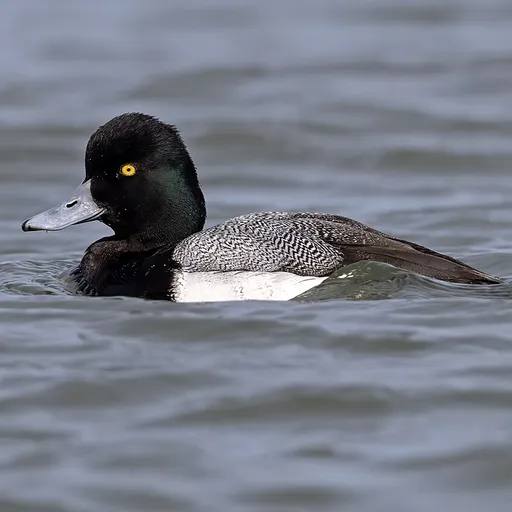
Lesser Scaup
Aythya affinis
Least Concern
Overview
The lesser scaup (Aythya affinis) is a small North American diving duck that migrates as far south as Central America and the Caribbean during winter. It is colloquially known as the little bluebill or broadbill due to its distinctive bill coloration. While currently classified as a Species of Least Concern by the IUCN, its population has experienced a significant decline since the mid-1980s.
Identification
- Adult males feature a black, iridescent head with a small hindcrown tuft, a black breast, and a whitish-grey back, while females are dark brown with a white band at the base of the bill.
- Both sexes possess a blue-grey bill with a small black nail at the tip and white secondary remiges, distinguishing them from the similar greater scaup.
- In flight, the white wing markings are confined to the secondaries, whereas in the greater scaup they extend towards the wingtip.
- Hens produce a discordant, guttural 'scaup' call that is weaker than that of the greater scaup.
Habitat
Breeding habitats consist of inland lakes and arctic marsh ponds in Alaska, western Canada, and western Montana, with migration occurring primarily via the Central and Mississippi Flyways. Wintering grounds include lakes, rivers, and sheltered coastal lagoons and bays from the US–Canada border to northern Colombia, though the birds rarely venture offshore when fresh water is available. They are occasionally recorded as vagrants in western Europe, the Hawaiian Islands, and Japan.
Diet
Lesser scaup forage mainly by sifting through bottom mud underwater, consuming mollusks such as mussels and clams alongside aquatic plant seeds and vegetation like sedges and wild rice. In winter, their diet incorporates crustaceans, insect larvae, and small fishes. Some populations have shifted migration routes to exploit zebra mussels in Lake Erie, although this poses risks due to bioaccumulation of contaminants.
Did you know?
The etymology of the name 'scaup' is debated, possibly deriving from the Scottish word for clams and oysters which the bird favors, or from the female's discordant call. Remarkably, the species has shifted its traditional migration routes to take advantage of zebra mussels introduced to Lake Erie in the 1980s.
Sources
- Wikipedia · CC BY-SA 4.0
- Wikidata · CC0 1.0