
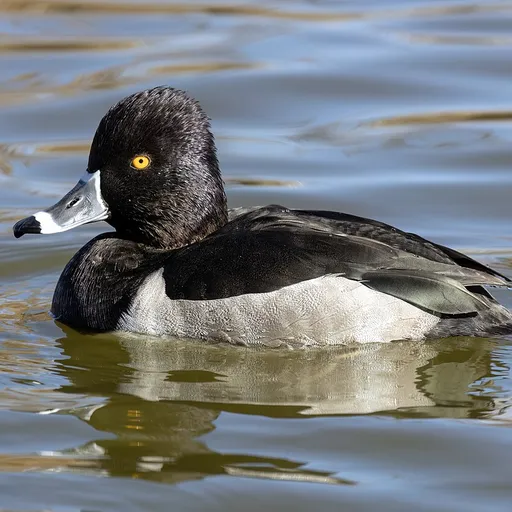
Ring-necked Duck
Aythya collaris
Least Concern
Listen
XC938581 · Doug Hynes · St. Paul Island, Nova Scotia, Canada · CC BY-SA 4.0
Overview
The ring-necked duck (Aythya collaris) is a small to medium-sized diving duck native to North America. It is commonly found in freshwater ponds and lakes and is classified as a species of Least Concern on the IUCN Red List.
Identification
- Adult males feature a shiny black angular head, a black back, and a white breast, with a white line on the wings and yellow eyes.
- Distinguished by two white rings surrounding its gray bill, which can be difficult to observe, leading to the common alternative name 'ringbill'.
- Adult females have a grayish brown angular head and body, a dark brown back, and grayish-blue feet with brown eyes.
- Males are slightly larger than females, with a total length of 39–46 cm and a wingspan of 62–63 cm.
Habitat
Breeding habitat consists of wooded lakes or ponds in the northern United States and Canada, primarily within Northwest boreal forest territories. In winter, the species migrates to southern North America, utilising lakes, ponds, rivers, and bays.
Diet
These omnivorous birds feed mainly by diving or dabbling at the surface. Ducklings rely on animal matter such as insects, earthworms, leeches, midges, and snails, while mature individuals transition to submerged plants like pondweed and coontail, as well as emergent plants such as annual wild rice.
Did you know?
Although a North American species, it is a rare but regular vagrant to western Europe, with occasional small flocks recorded in locations such as Loch Leven in Scotland and Standlake in Oxfordshire. Vagrant individuals also appear regularly in Central America as far south as Costa Rica between October and June.
Sources
- Wikipedia · CC BY-SA 4.0
- Wikidata · CC0 1.0