
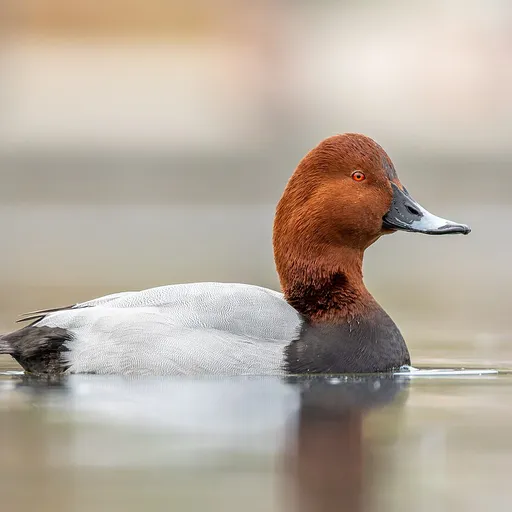
Common Pochard
Aythya ferina
Vulnerable
Listen
XC730801 · Sonothèque ADVL · Val-Couesnon, Ille-et-Vilaine, Bretagne, France · CC0 1.0
Overview
The common pochard, known simply as pochard in the United Kingdom, is a medium-sized diving duck in the family Anatidae. It is widespread across the Palearctic and is currently classified as Vulnerable by the IUCN due to significant population declines in various regions.
Identification
- Male has a chestnut-coloured head and neck, a black breast and tail, and a pale grey body with fine vermiculations.
- Stocky and short-tailed with a sloping forehead and a relatively long, dark grey bill featuring a wide blue-grey band across the middle.
- Measures 42–49 cm in length with a wingspan of 72–82 cm; males are larger and heavier than females.
- Male is generally silent but may whistle softly during courtship, while the female emits a soft growl when flushed.
Habitat
Breeding habitat consists of marshes and lakes with a metre or more water depth across temperate and northern Europe and the Palearctic. The species is migratory, breeding primarily in Scandinavia and the steppe regions of Siberia, and wintering further south and west, including in large numbers in Great Britain.
Diet
Feeds on plant material, small fish, molluscs, and other aquatic invertebrates, primarily by diving to retrieve items from under the water's surface, though it will also upend and dabble. Most feeding occurs at night, and the birds often forage in close association with Bewick's and whooper swans, which helps them glean food items and can double their food intake rate.
Did you know?
In some populations, as many as 89% of nests contain one or more eggs laid by other females, a behaviour known as parasitic egg-laying, and these parasitic eggs can make up to 37% of the total clutch.
Sources
- Wikipedia · CC BY-SA 4.0
- Wikidata · CC0 1.0