
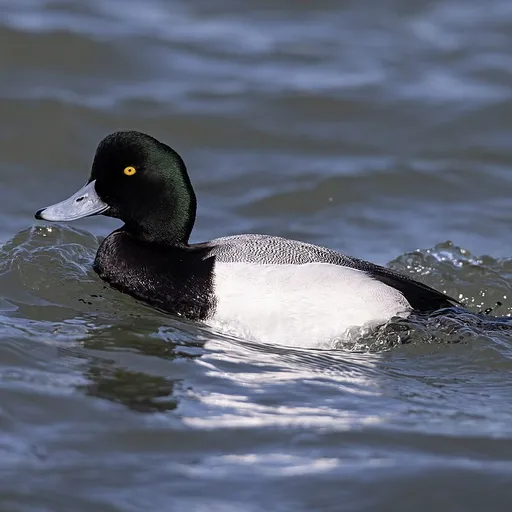
Greater Scaup
Aythya marila
Least Concern
Overview
The greater scaup, also known as the bluebill in North America, is a mid-sized diving duck that is larger than the closely related lesser scaup. It is a circumpolar species that breeds within the Arctic Circle and migrates south to winter along the coasts of Europe, Asia, and North America.
Identification
- The male has a dark head with a green to purple gloss, a black breast, a white belly, and a light blue-grey bill with a small black nail.
- The female is predominantly brown with a white facial patch and dull blue bill.
- Both sexes feature a strong white stripe on the wing and grey legs.
- The drake produces a soft, quick whistle, while the female has a single-pitch, raspy call.
Habitat
Breeding occurs in marshy lowland tundra and boreal forest, typically on islands in northern lakes or on floating mats of vegetation. In winter, they inhabit coastal bays, estuaries, and inland lakes, including the Great Lakes. The species has a circumpolar distribution across the Palearctic and Nearctic, though small populations in Iceland and the Aleutian Islands remain year-round.
Diet
Greater scaup forage by diving underwater to depths of 0.5–6 m, exceptionally up to 10 m, to feed on aquatic molluscs, plants, and insects. In summer, they also consume small aquatic crustaceans, and in freshwater ecosystems, they eat seeds, leaves, stems, and roots of plants such as sedges and pondweeds.
Did you know?
The English name 'scaup' likely derives from 'scaup' or 'scalp', a Scottish and Northern English term for a shellfish bed, reflecting the birds' winter feeding habits, or possibly from the mating call 'scaup scaup'.
Sources
- Wikipedia · CC BY-SA 4.0
- Wikidata · CC0 1.0