
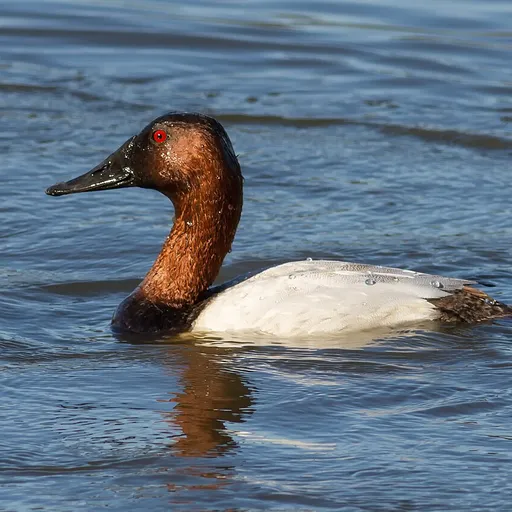
Canvasback
Aythya valisineria
Least Concern
Overview
The canvasback (Aythya valisineria) is the largest species of diving duck in North America and the largest member of the genus Aythya. It is classified as Least Concern on the IUCN Red List, though its populations have historically fluctuated due to habitat changes.
Identification
- Possesses a distinctive wedge-shaped head and long, graceful neck that creates a sloping profile.
- Adult males feature a chestnut-red head and neck, black breast, grayish back, and white sides with fine vermiculation resembling woven canvas.
- Adult females have a light brown head and neck grading into a darker brown chest, with grayish-brown sides and back.
- Both sexes have a black bill and bluish-gray legs and feet; the male's iris is bright red in spring but duller in winter.
Habitat
Breeds in North American prairie potholes, specifically on permanent marshes surrounded by emergent vegetation like cattails and bulrushes. Winters in brackish estuarine bays and marshes with abundant submergent vegetation, particularly in the mid-Atlantic United States and the Lower Mississippi Alluvial Valley. Migrates through the Mississippi and Pacific Flyways, with occasional rare sightings recorded in the United Kingdom.
Diet
Feeds mainly by diving, using large webbed feet and a specialized bill to dig for tubers and roots in the substrate. Prefers the tubers of sago pondweed and wild celery, but can adapt its diet; for instance, Baltic Clams have comprised up to four-fifths of its food in some regions. Also consumes seeds, buds, leaves, snails, and insect larvae.
Did you know?
The species name valisineria is derived from wild celery, which was historically its preferred food during the non-breeding period. Canvasbacks were once a highly prestigious game dish in 19th-century America, famously featuring on the elegant "Maryland Feast" menu.
Sources
- Wikipedia · CC BY-SA 4.0
- Wikidata · CC0 1.0