
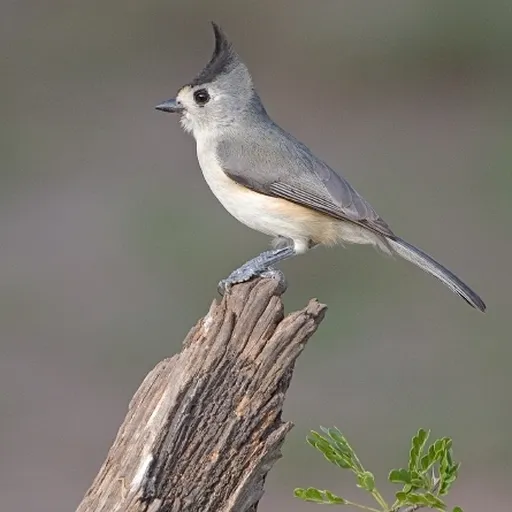
Black-crested Titmouse
Baeolophus atricristatus
Least Concern
Overview
The black-crested titmouse, also known as the Mexican titmouse, is a passerine bird in the family Paridae found in Mexico and parts of the United States. It is a year-round resident that is classified as Least Concern by the IUCN, with an estimated population of 1.2 million mature individuals.
Identification
- Approximately 15 cm long with a distinct crest that is black in adult males and dark gray in females.
- Deep plumbeous gray upperparts with a greenish cast, white throat and underparts, and rich cinnamon-rufous flanks.
- Features a buffy-white forehead, white lores, a white eye-ring with a black spot above it, and a black bill.
- Song consists of five to seven rapidly delivered slurred phrases sounding like 'peew peew peew peew peew'.
Habitat
This species inhabits a variety of landscapes including evergreen, semi-deciduous, and deciduous forests and woodlands, with a preference for oaks and mesquite. It also occupies human-modified areas such as orchards, parks, and residential zones, ranging in elevation from sea level to approximately 2,300 m. Its range covers Mexico, the U.S. states of Oklahoma and Texas, and it has been recorded as a vagrant in New Mexico.
Diet
The bird feeds mostly on insects, larvae, and eggs, supplemented by nuts, seeds, berries, corn, and human-provided foods such as suet and bread. It forages deliberately on trunks, branches, and foliage, predominantly in the inner parts of trees. In winter, it often forages in mixed-species flocks with other parids, kinglets, gnatcatchers, and warblers.
Did you know?
Despite other members of its family regularly storing food, the black-crested titmouse is not known to cache its meals. It also demonstrates adaptability by lining its nests with human-made materials such as fabric and string alongside natural items like moss and grass.
Sources
- Wikipedia · CC BY-SA 4.0
- Wikidata · CC0 1.0