
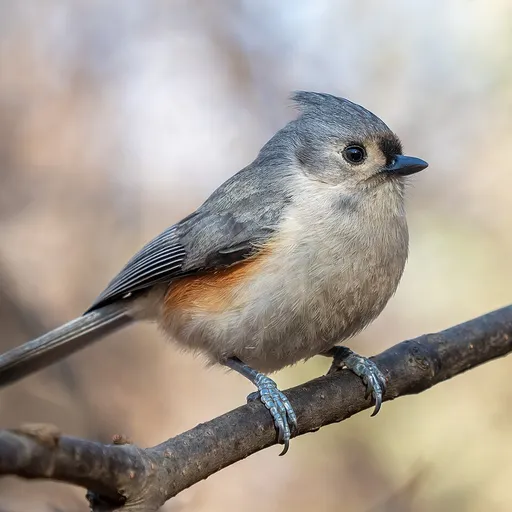
Tufted Titmouse
Baeolophus bicolor
Least Concern
Listen
XC789382 · The Vermont Birder Guy · Swanton (near Sheldon), Franklin County, Vermont, United States · CC0 1.0
Overview
The tufted titmouse (Baeolophus bicolor) is a small songbird native to eastern North America and part of the tit and chickadee family. It has a large breeding population and is currently classified as Least Concern on the IUCN Red List.
Identification
- Length of 14–16 cm with a white front, grey upper body, and rust-coloured flanks.
- Distinctive black forehead and a tufted grey crest on the head.
- Song is described as a whistled 'peter-peter-peter', which can vary in about 20 notable ways.
Habitat
This species inhabits deciduous and mixed woods, gardens, parks, and shrublands. Although originally native to the Ohio and Mississippi River basins, its range has expanded northwards into Ontario and Quebec in Canada.
Diet
Diet consists of berries, nuts, seeds, small fruits, insects, and invertebrates, with caterpillars being a major component in summer. It forages on the ground and tree branches, frequently caching seeds and preferring sunflower seeds and suet at bird feeders.
Did you know?
The tufted titmouse practises kleptotrichy by plucking hair from live mammals to line its nest and may also incorporate pieces of snakeskin sheddings. Its offspring often remain with their parents through the winter and may assist in raising the next year's young.
Sources
- Wikipedia · CC BY-SA 4.0
- Wikidata · CC0 1.0