
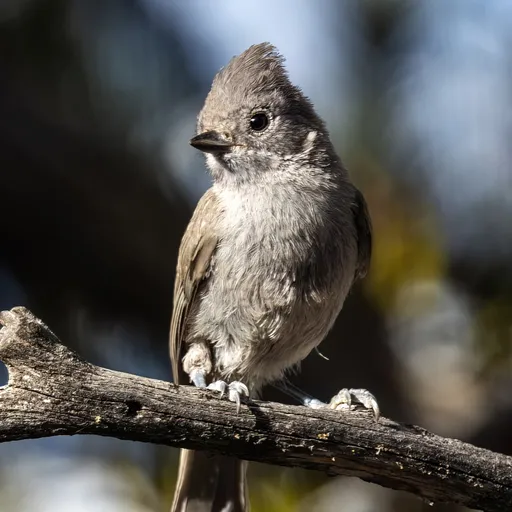
Juniper Titmouse
Baeolophus ridgwayi
Least Concern
Overview
The juniper titmouse (Baeolophus ridgwayi) is a small passerine bird in the tit family Paridae. It was split from the plain titmouse in 1996 based on distinct differences in song, habitat preference, and genetic makeup.
Identification
- Small, gray bird with a small tuft or crest; males and females are visually similar.
- Song is a rolling series of rapid syllables on the same pitch.
- Call sounds like a raspy tschick-adee.
- Strong legs allow the bird to hang upside down while foraging.
Habitat
Resident year-round primarily in the Great Basin, extending from southeastern Oregon and central Colorado south to the eastern Mojave Desert in California and central Arizona, as far as west Texas and extreme northeastern Sonora, Mexico. It prefers open woodlands of warm, dry pinyon-juniper, juniper, and desert riparian woods.
Diet
Eats insects and spiders, sometimes catching insects in mid-air, as well as berries, acorns, and seeds. It forages on foliage, twigs, branches, trunks, and occasionally on the ground, using strong legs to hang upside down. The bird may hammer seeds against branches to open them and visits feeders with suet, peanut butter, and seeds.
Did you know?
When roosting in foliage, the titmouse chooses a twig surrounded by dense foliage or an accumulation of dead pine needles, simulating a roost in a cavity.
Sources
- Wikipedia · CC BY-SA 4.0
- Wikidata · CC0 1.0