
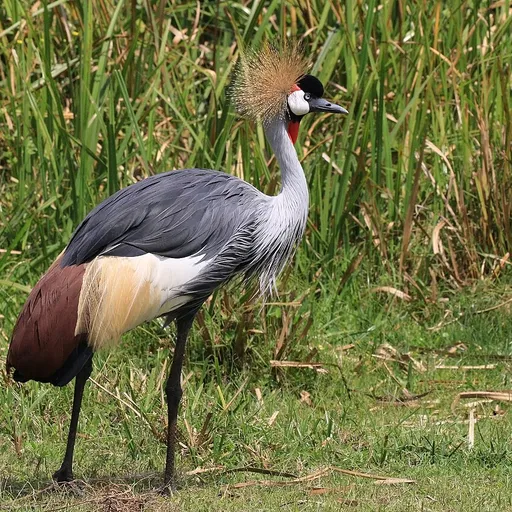
Grey Crowned Crane
Balearica regulorum
Endangered
Overview
The grey crowned crane, or gray crowned crane (Balearica regulorum), is a large crane species native to Sub-Saharan Africa. Listed as endangered on the IUCN Red List, its global population is estimated between 58,000 and 77,000 individuals. It serves as the national bird of Uganda and is featured on the country's flag.
Identification
- Approximately 1 m tall with a 2 m wingspan, featuring mainly grey body plumage and predominantly white wings with dark grey, dark red, and golden yellow patches.
- Distinctive head markings include a crown of stiff golden feathers, white facial sides, and a bright red inflatable throat pouch.
- Possesses a relatively short grey bill and long black legs with large, slender feet adapted for balance.
- Produces a booming call involving the inflation of the red gular sac and a honking sound distinct from other cranes.
Habitat
Occurring mainly in dry savannah across Sub-Saharan Africa, the species nests in somewhat wetter habitats such as marshes, cultivated lands, and grassy flatlands near rivers and lakes. Its range extends from Uganda and Kenya as far south as South Africa, with birds near the tropics typically being sedentary while those in arid areas make localised seasonal movements.
Diet
As an omnivore, it consumes a wide variety of animal and plant matter, including plants, seeds, grain, insects, frogs, worms, snakes, small fish, and the eggs of aquatic animals. It forages by stamping its feet to flush out insects and often associates with grazing herbivores to catch prey disturbed by antelopes and gazelles.
Did you know?
This species and the black crowned crane are the only cranes that can roost in trees, a trait attributed to a long hind toe that can grasp branches. Chicks of the species have been observed in ceremonies akin to weddings, where two offspring are married off by dancing before flying off together to start a new family.
Sources
- Wikipedia · CC BY-SA 4.0
- Wikidata · CC0 1.0