
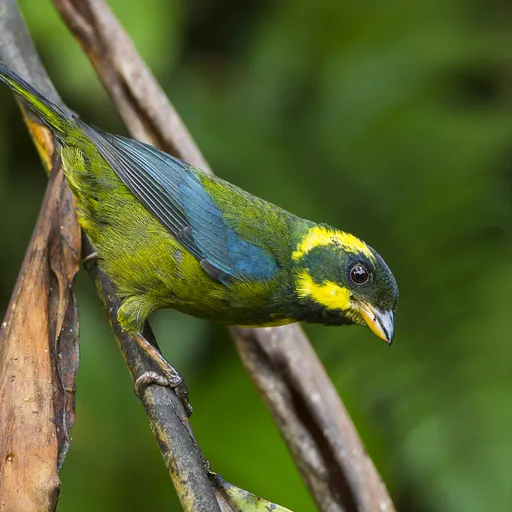
Gold-ringed Tanager
Bangsia aureocincta
Vulnerable
Overview
The gold-ringed tanager (Bangsia aureocincta) is a plump, relatively short-tailed bird in the family Thraupidae, endemic to Colombia. It is classified as Vulnerable on the IUCN Red List due to its limited range and specific habitat requirements.
Identification
- Approximately 16 cm in length and weighing 35–45 g, the bird is predominantly dark green with a bright orange-yellow centre to the breast.
- Adults possess a distinctive 'gold ring' formed by bright yellow postocular and malar stripes surrounding the olive-green cheeks and auriculars.
- The bill is black on the upper mandible and horn-coloured on the lower, with dark red irises and greyish feet.
- Females are similar to males but feature narrower, greener facial markings and duller yellow and green plumage.
Habitat
This species inhabits wet, mossy, mature or secondary high-altitude cloud forest on the slopes of the western cordillera of the Andes, typically at altitudes between 1350 and 2195 m. It prefers continuous tracts of natural forest immersed in orographic clouds and avoids fragmented habitats, pastures, and human settlements.
Diet
The diet consists of 70–90% fruit, including species from the Ericaceae, Rubiaceae, and Araceae families, alongside insects. Foraging is often described as deliberate or sluggish, occurring among moss and epiphytes on branches or on the ground, and the birds may sally for insects or join mixed-species feeding flocks.
Did you know?
The species is known to be silent and elusive during the breeding season, with well-hidden nests that make observation difficult. Some authorities suspect that birdwatchers use call recordings to lure the birds, which might interfere with their reproduction.
Sources
- Wikipedia · CC BY-SA 4.0
- Wikidata · CC0 1.0