
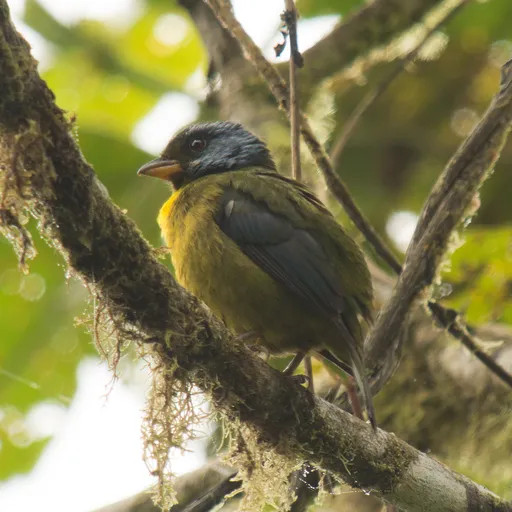
Moss-backed Tanager
Bangsia edwardsi
Least Concern
Overview
The moss-backed tanager is a chunky, large-headed species of bird in the family Thraupidae, endemic to the Western Andes of western Colombia and northwestern Ecuador. Classified as Least Concern by the IUCN, it inhabits dense, humid Pacific slope forests and is currently experiencing a population decline due to habitat loss.
Identification
- Upperparts are mostly moss-green with dark blue-tinged dark green wings, while underparts are olive green with a bright golden yellow patch on the chest.
- The head is black from the throat to the central nape, featuring shining blue sides.
- The bill is stubby and bicolored, with a dusky upper mandible and a yellow lower mandible; eyes are brown and legs are gray.
- Males and females appear similar in the visible spectrum, though males reflect UV light more strongly; immatures are duller than adults.
Habitat
This species is endemic to the Western Andes of western Colombia and northwestern Ecuador, where it inhabits dense, humid Pacific slope forests. It typically occupies premontane forests between tropical lowland and montane evergreen forests, found at elevations of 600–2200 m in Colombia and usually 500–1100 m in Ecuador, though records in Ecuador reach up to 1700 m. It has a somewhat discontinuous distribution and is also recorded from woodland edge, secondary growth, and clearings.
Diet
The moss-backed tanager feeds on insects and fruit, foraging in the middle or upper canopy, sometimes at lower strata. Individuals or pairs glean arthropods from thick vegetation and epiphytes, flutter-pursue flushing insects, and sally for flying invertebrates, while also perching to consume fruit. They have been observed foraging near army ant swarms alongside uniform antshrikes and often sit on open perches for extended periods.
Did you know?
Males of this species reflect UV light more strongly than females, a difference not visible to the human eye. The bird was named after the French zoologist Henri Milne-Edwards.
Sources
- Wikipedia · CC BY-SA 4.0
- Wikidata · CC0 1.0