
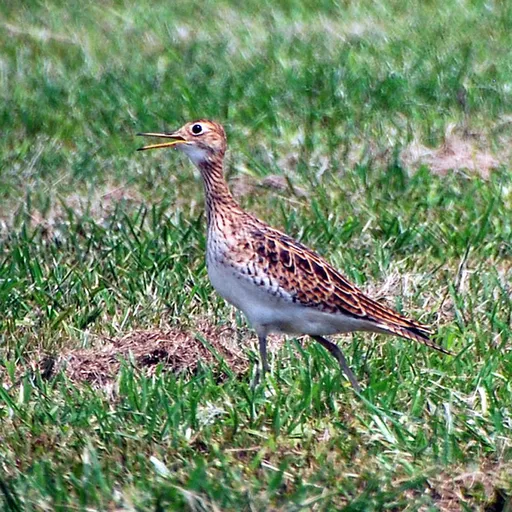
Upland Sandpiper
Bartramia longicauda
Least Concern
Listen
XC251249 · Niels Krabbe · Loja: 1 km N Yangana along main road, Ecuador · CC BY-SA 4.0
Overview
The upland sandpiper is a large sandpiper closely related to curlews and is the sole extant member of the genus Bartramia longicauda. Known colloquially as the papabotte in Louisiana, it is an odd-looking bird that prefers open, grassy landscapes over traditional coastal habitats.
Identification
- Approximately 30 cm long with a 66 cm wingspan and an average weight of 170 g, featuring a small, dove-like head on a long neck.
- Plumage is heavily marbled black and brown on the back and wings, with dark brown streaking continuing down the neck to the breast and flanks, contrasting with a white belly and long tail.
- Distinctive white eye-ring and long yellow legs.
- A distinctive call often described as a 'wolf whistle', consisting of a long ascending whistle followed by a second rising or falling call, typically heard while flying high or landing.
Habitat
Despite being a sandpiper, this species prefers open country with tall grasses, such as prairies, airports, and blueberry farms, rather than coastal areas. Its core range is in the northern Midwest United States, with breeding occurring from eastern Alaska through Montana to Pennsylvania and New England, and wintering in northeastern Argentina, Uruguay, and southern Brazil.
Diet
Upland sandpipers forage in fields by sight, consuming a diverse diet of insects including grasshoppers, crickets, weevils, beetles, moths, ants, flies, bugs, centipedes, millipedes, spiders, snails, and earthworms, as well as some grains and seeds.
Did you know?
Between September and October, hundreds of upland sandpipers migrate to the Ozogoche lagoons in southern Ecuador, where they dive into the icy waters and die of hypothermia, a behaviour whose exact explanation remains uncertain.
Sources
- Wikipedia · CC BY-SA 4.0
- Wikidata · CC0 1.0