
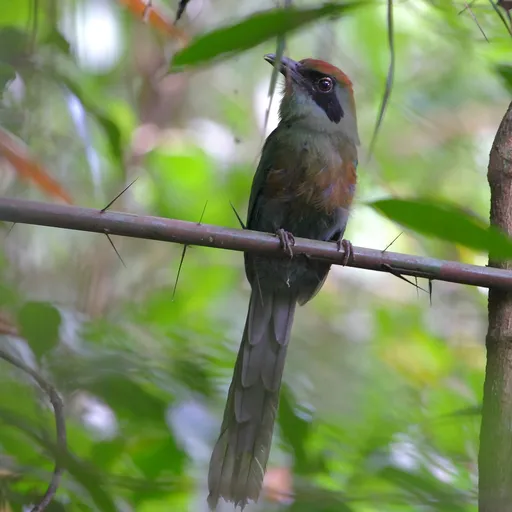
Rufous-capped Motmot
Baryphthengus ruficapillus
Least Concern
Overview
The rufous-capped motmot (Baryphthengus ruficapillus) is a species of bird in the family Momotidae found across parts of South America. It is one of only two species in its genus and is assessed by the IUCN as being of Least Concern, although its population is currently in decline due to deforestation.
Identification
- Approximately 42 cm long, with plumage that is mostly green above and olive-green below.
- Distinctive rufous crown and nape featuring a black mask bordered in turquoise.
- A black spot is present on the chest, accompanied by a rufous band across the belly and a blue-green lower belly.
- Vocalises mostly before dawn and at dusk with a series of 'hoo-oo-oo-oo-oo' notes that resemble owl calls.
Habitat
Found in southeastern Brazil, eastern Paraguay, and far northeastern Argentina, ranging in elevation from near sea level to 1,200 m. The species inhabits primary and gallery forest, with the latter mostly located along watercourses.
Diet
The rufous-capped motmot maintains a cosmopolitan diet consisting of insects, their larvae, spiders, snails, small reptiles, mammals, birds, and to a lesser extent, fruits. It has been observed following army ants to capture disturbed prey and sometimes forages in mixed-species flocks.
Did you know?
This species nests in burrows within earth banks that can exceed 1 m in length, either digging its own or repurposing abandoned burrows dug by other animals such as armadillos. It typically lays two or three eggs, likely in September and October.
Sources
- Wikipedia · CC BY-SA 4.0
- Wikidata · CC0 1.0