
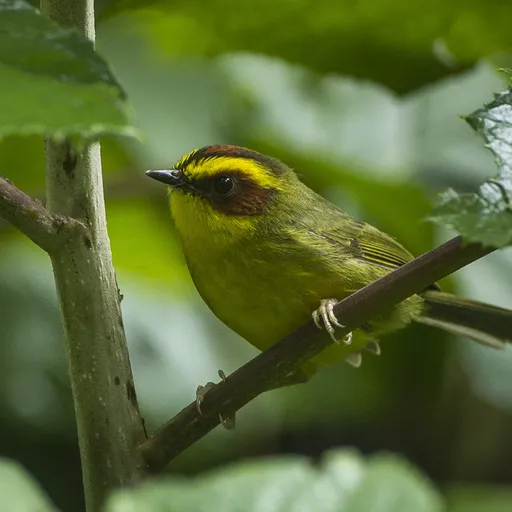
Golden-browed Warbler
Basileuterus belli
Least Concern
Overview
The golden-browed warbler (Basileuterus belli) is a species of New World warbler found in El Salvador, Guatemala, Honduras, and Mexico. It is a sedentary year-round resident classified as Least Concern by the IUCN, with an estimated population of at least 50,000 mature individuals.
Identification
- Measures 13 cm in length and weighs 7 to 13 g, featuring a blackish bill, dusky pinkish legs, and a dark iris.
- Adults of the nominate subspecies display blackish lores, a rufous crown and ear coverts separated by a thin black line, and a long bright yellow supercilium.
- Upperparts, wings, and tail are bright olive-green, while the throat and underparts are mostly bright yellow with an olive wash on the breast sides and flanks.
- Song described as a rapid series of high-pitched notes often upslurred at the end, or a rich warble with repeated elements; call is a high, drawn-out bzweeech or sharp seet.
Habitat
The species primarily inhabits pine-oak forest and cloudforest with dense understories, ranging in elevation between approximately 1,250 and 3,500 m, though it mostly occurs above 2,000 m south of Mexico. Its distribution is highly disjunct across western and eastern Mexico, southern Guatemala, western Honduras, and northern El Salvador.
Diet
The diet has not been formally studied but is believed to consist primarily of insects and other arthropods. Pairs or small family groups forage low in the understory by gleaning from vegetation and seldom join mixed-species feeding flocks.
Did you know?
The bird was originally described in 1841 under the binomial Muscicapa belli and given the English name Bell's Fly Catcher. Its estimated population is believed to be decreasing despite no immediate threats being identified.
Sources
- Wikipedia · CC BY-SA 4.0
- Wikidata · CC0 1.0