
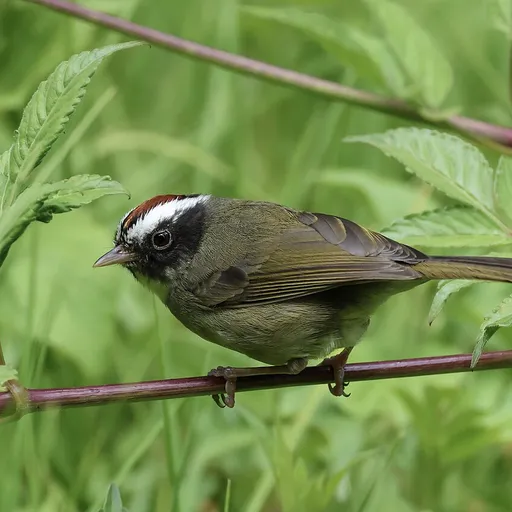
Black-cheeked Warbler
Basileuterus melanogenys
Least Concern
Overview
The black-cheeked warbler (Basileuterus melanogenys) is a species of bird in the family Parulidae, the New World warblers, found in Costa Rica and Panama. It is currently classified as Least Concern by the IUCN Red List, though its population is believed to be decreasing.
Identification
- Adults have a chestnut crown, white or pale yellowish supercilium, and a thin black line between them on an otherwise blackish face.
- The nape is sooty blackish on the sides and dark brownish gray or olive on the rest; the back, wings, and tail are dusky brownish gray, while the rump and uppertail coverts are olive.
- Underparts feature a whitish throat, grayish breast, olive flanks, and buffy white center of the belly and undertail coverts.
- It is about 13.5 cm long and weighs approximately 12 g, with a dark brown iris, a dusky black maxilla, a pink mandible, and pale brownish white legs.
Habitat
The species inhabits the understory of montane evergreen forest, elfin forest, and secondary forest in subtropical and temperate zones, often preferring bamboo-choked ravines and oak forest understory. It shuns clearings and pastures, ranging in elevation from 1,600 m to above timberline at about 3,500 m in Costa Rica.
Diet
The diet is primarily composed of insects and other arthropods with small amounts of berries, which are gleaned from vegetation by pairs or small family groups that forage acrobatically from the understory to the mid-level of the forest. It regularly joins mixed-species feeding flocks, though usually for only a short time.
Did you know?
The black-cheeked warbler breeds by constructing an oven-shaped nest from plant fibers placed on the ground or an earthen bank, containing glossy white eggs speckled with cinnamon rufous flecks.
Sources
- Wikipedia · CC BY-SA 4.0
- Wikidata · CC0 1.0