
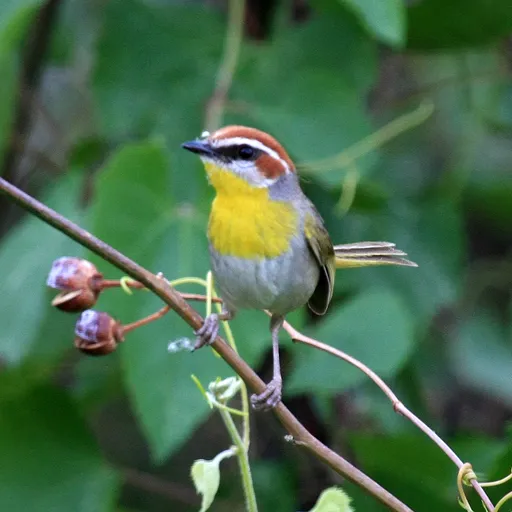
Rufous-capped Warbler
Basileuterus rufifrons
Least Concern
Overview
The rufous-capped warbler (Basileuterus rufifrons) is a species of New World warbler found in Belize, Guatemala, and Mexico, with occasional vagrant records in the southwestern United States. Classified as Least Concern on the IUCN Red List, it is common in Mexico and fairly common in its Central American range.
Identification
- Males and females both display a rufous crown and ear coverts, set off by a long white supercilium and black lores.
- Adults possess a lemon-yellow throat and upper breast, contrasting with brownish-white underparts and olive-gray upperparts.
- At approximately 13 cm long, the bird has a blackish bill and pinkish legs and feet, with dark eyes.
- Vocalisations include a fast-paced trill described as "tsip-tsip-tsip-three'three'three'sea'sea'tawhee!" and an agitated hard "tcheck" that often extends into harsh chatter.
Habitat
This sedentary bird inhabits varied dry and open landscapes, including scrublands, open woodlands, hedgerows, shade coffee plantations, and the edges of mature forests, though it avoids forest interiors. Its range spans from sea level up to 3,000 m, although populations south of Mexico typically reside between 450 and 2,150 m.
Diet
Primarily insectivorous, the rufous-capped warbler consumes other invertebrates and occasionally berries. It forages deliberately by gleaning food from vegetation in the lower to mid-levels of its habitat and may join mixed-species feeding flocks.
Did you know?
Although it is generally a year-round resident, the subspecies B. r. caudatus is a regular visitor to southeastern Arizona and Texas, and has occasionally bred within the U.S.
Sources
- Wikipedia · CC BY-SA 4.0
- Wikidata · CC0 1.0