
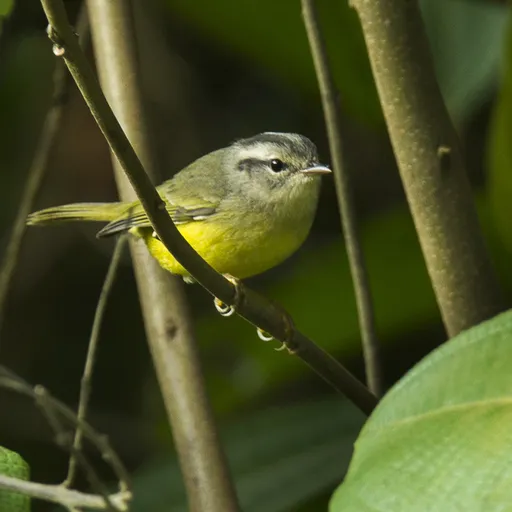
Three-banded Warbler
Basileuterus trifasciatus
Least Concern
Listen
XC242244 · Niels Krabbe · Loja: Celica mts.: w-slope between Celica and Guachanamá, Ecuador · CC BY-SA 4.0
Overview
The three-banded warbler (Basileuterus trifasciatus) is a species of New World warbler found in Ecuador and Peru. It is classified as Least Concern on the IUCN Red List, though its population is believed to be decreasing.
Identification
- A small bird measuring 12.5 cm in length, with medium gray upperparts, an olive back and wings, and white throat that transitions to yellow underparts smudged with gray on the upper breast.
- Distinctive head markings include a pale gray crown stripe with black borders, grayish white lores and supercilium, a thin black eye-stripe, and medium gray ear coverts with a blackish rear edge.
- Features a blackish horn upper bill, a paler horn lower bill, a dark iris, and dusky pinkish legs and feet.
- Song is a warbling and pulsating trill that rises slightly in pitch, accompanied by a sharp, regularly repeated 'tsit' call.
Habitat
This species inhabits the interior and edges of submontane and montane rainforest, as well as mature secondary forest with dense understory and watercourses in dryer forest. It is found on the western slopes of the Andes in southwestern Ecuador and northwestern Peru, ranging from 800 to 2,400 m in Ecuador and 650 to 3,000 m in Peru.
Diet
While its diet has not been formally studied, it is believed to feed primarily or solely on invertebrates. It forages by gleaning from vegetation, mostly in the forest understory, and individuals or groups sometimes join mixed-species feeding flocks.
Did you know?
The species was formally described in 1880, but some taxonomic authors have treated it as a subspecies of the golden-crowned warbler rather than a distinct species.
Sources
- Wikipedia · CC BY-SA 4.0
- Wikidata · CC0 1.0