
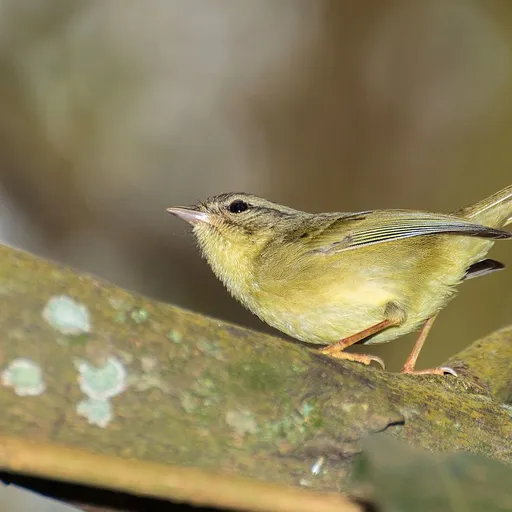
Three-striped Warbler
Basileuterus tristriatus
Least Concern
Listen
XC250541 · Niels Krabbe · Zamora-Chinchipe: Filo de Chumbiriatza, tepui 4.5 km SW Las Orchideas, above "Cabañas Yankuam", Nangaritza Valley, Ecuador · CC BY-SA 4.0
Overview
The three-striped warbler, Basileuterus tristriatus, is a species of bird in the family Parulidae, known as a New World warbler. It inhabits the Andes mountain range from Venezuela south to Bolivia. Despite a large range, its population is believed to be decreasing due to habitat destruction from agriculture and logging.
Identification
- Approximately 13 cm long, with uniform plumage between sexes and olive upperparts with a gray wash.
- Head features a buffy-yellow crown stripe, a wide black stripe below, and a long pale supercilium, with blackish lores and ear coverts.
- Underparts are mostly pale yellow, brightest on the belly, with whitish throats and olive-gray washes on the breast and flanks.
- Song varies by region, often described as a loud, high, ringing crescendo of chipping notes or an unmusical, agitated chipping sequence.
Habitat
Found in humid montane forests and mature secondary forests in the foothills and subtropical zones of the Andes. Its distribution is disjunct, with subspecies occupying separate ranges across Venezuela, Colombia, Ecuador, and Peru. Elevational ranges vary by country, generally between 800 and 2,700 m, though most records are below 2,300 m.
Diet
Although not formally studied, its diet is thought to be primarily invertebrates. Pairs or small family groups forage in the forest understory, gleaning food from vegetation and occasionally taking prey in mid-air with a short sally. The species regularly joins mixed-species feeding flocks.
Did you know?
The genus name Basileuterus derives from the Ancient Greek basileuteros, meaning 'more kingly'. Despite this royal etymology, the bird was originally described as Myiodioctes tristriatus, a name that highlights its striped appearance rather than any regal status.
Sources
- Wikipedia · CC BY-SA 4.0
- Wikidata · CC0 1.0