
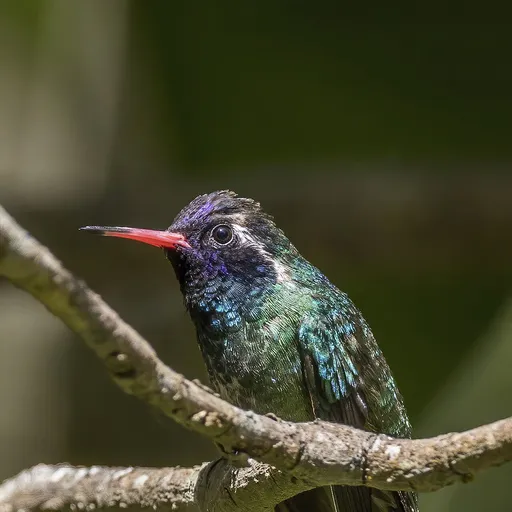
White-eared Hummingbird
Basilinna leucotis
Least Concern
Overview
The white-eared hummingbird (Basilinna leucotis) is a species of hummingbird found from the southwestern United States to Nicaragua. It is classified as Least Concern on the IUCN Red List and is considered fairly common to common throughout its range.
Identification
- Length of 9 to 10 cm with straight bills; males have red bills with black tips, while females have mostly blackish bills with red or orange bases.
- Males in breeding plumage feature a metallic violet forehead, a black face with a wide white stripe behind the eye, and bright metallic green upperparts.
- Females have a dusky brown crown and lack the brilliant throat of males, displaying underparts that are pale brownish grey to greyish white with metallic bronze green spots.
- Song described as a tedious, metallic chipping sequence such as chi'tink chi'tink or tink tink, with calls of hard, dry chips.
Habitat
Inhabits montane regions, specifically the interior, clearings, and edges of pine, pine-oak, and pine-evergreen forests between elevations of 1,200 and 3,500 m. The range spans from the southwestern U.S. through Mexico into Nicaragua, with the B. l. borealis subspecies in southern Arizona and northern Mexico, and the B. l. pygmaea subspecies in Central America.
Diet
Forages for nectar from a wide variety of flowering plants and shrubs, primarily in the low to mid-levels of vegetation, and also feeds on small insects. It actively defends feeding territories against other hummingbirds and occasionally makes secretive low approaches to feed in the territories of larger species.
Did you know?
The species is considered less vulnerable to habitat fragmentation than many other montane forest species because it utilises forest edges.
Sources
- Wikipedia · CC BY-SA 4.0
- Wikidata · CC0 1.0