
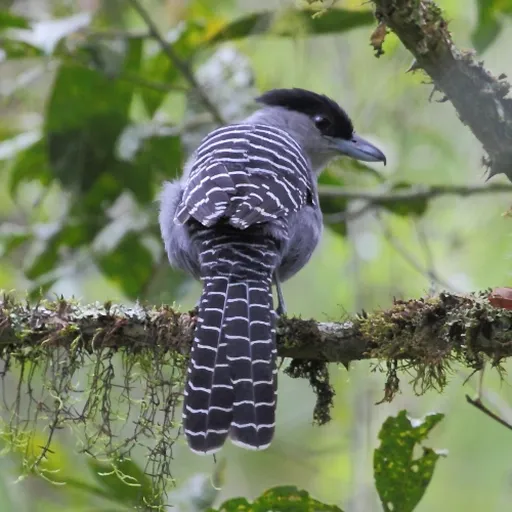
Giant Antshrike
Batara cinerea
Least Concern
Overview
The giant antshrike (Batara cinerea) is a species of bird in the family Thamnophilidae, notable as the largest antbird. It is classified as Least Concern on the IUCN Red List, with a large range despite a believed population decline.
Identification
- Measures 27 to 35 cm in length and weighs between 100 and 155 g, featuring a crest and a very long, wide tail.
- Possesses a long gray bill with a distinct hook at the end, similar to that of true shrikes.
- Adult males display a black forehead, crown, and crest, with black-and-white barred back, wings, and tail, and neutral gray face and underparts.
- Adult females have a rufous crest with black tips, cinnamon-buff and dark brown barred upperparts, and olive to yellowish underparts.
- The song consists of a short trill followed by a fast series of notes that increase in strength and pitch before decelerating, accompanied by a long, raspy, downward-inflected snarl.
Habitat
Found in Argentina, Bolivia, Brazil, and Paraguay, this species inhabits the understorey to mid-storey of humid evergreen forests, elfin forests, and dense vegetation along ravines and streams. It frequently occupies stunted woodlands in the semi-arid Gran Chaco, favouring dense thorny thickets. The bird is almost always found in or near large stands of bamboo and does not survive in small residual forest patches.
Diet
Feeds on a variety of large insects and arthropods, as well as molluscs, small vertebrates such as frogs, lizards, and snakes, and possibly mice, nestling birds, and bird eggs. It forages singly or in pairs, typically below 5 m but up to 15 m above the ground, by hopping and making short flights to glean prey from leaves, stems, and branches. It does not join mixed-species feeding flocks.
Did you know?
Despite being the largest member of the antbird family, it does not actually feed on ants but instead preys on larger arthropods and small vertebrates. The species exhibits significant sexual dimorphism, with males and females having distinctly different plumage colours.
Sources
- Wikipedia · CC BY-SA 4.0
- Wikidata · CC0 1.0