
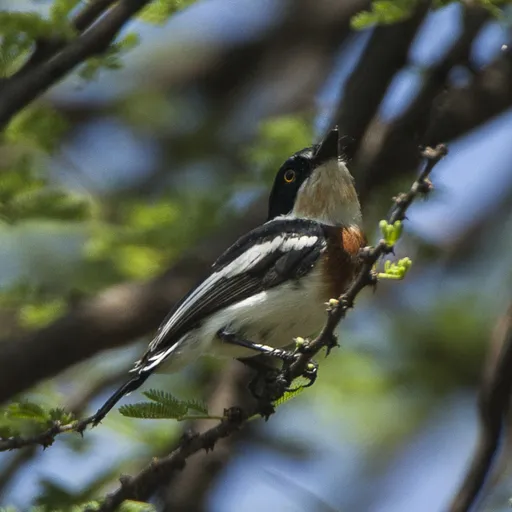
Pygmy Batis
Batis perkeo
Least Concern
Listen
XC1163472 · Frank shirima · Kudu Hills,Mererani, Simanjiro, Manyara Region, Tanzania · CC BY-SA 4.0
Overview
The pygmy batis (Batis perkeo) is a very small insectivorous bird belonging to the wattle-eyes family, Platysteiridae. It is characterised as a tiny, dumpy yet dapper species that forages primarily among leaves. This bird is classified as Least Concern on the IUCN Red List.
Identification
- A tiny bird measuring 8–9 cm in length with a body weight of 5–9 g, exhibiting a black, white and grey plumage with similarities to flycatchers.
- Males possess a bluish-grey head and back, a contrasting black face mask, a short white supercilium above a yellow eye, and a narrow black breast band, whereas females display a pale rufous-buff breast band and buffy brown masks and wing stripes.
- The wings are black with a broad white strip formed by feather edges, and the tail is black with white-edged outer feathers; the bill and legs are entirely black.
- The main call is a long series of repeated sharp, high-pitched whistles.
Habitat
The pygmy batis inhabits dry savannahs across north-eastern Africa, specifically found in southern Ethiopia, extreme south-eastern South Sudan, southern Somalia, eastern Uganda, inland Kenya and north-eastern Tanzania. It prefers scrub composed of Senegalia spp, Commiphora spp and other thorn species in arid and semi-arid lowlands with annual rainfall between 250 and 500 mm, and also occurs in wooded and bushy grassland while avoiding riverine forest.
Diet
This active, arboreal bird forages mainly within the foliage, gleaning insect prey from leaves and twigs, while taking a small proportion of food on the wing. It is known to join other bird species in mixed foraging parties.
Did you know?
Egg laying for the pygmy batis probably occurs in February and March, although its breeding biology remains almost unknown.
Sources
- Wikipedia · CC BY-SA 4.0
- Wikidata · CC0 1.0