
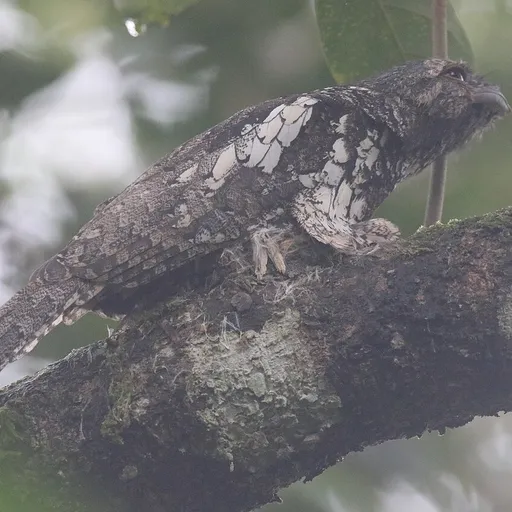
Sunda Frogmouth
Batrachostomus cornutus
Least Concern
Overview
The Sunda frogmouth (Batrachostomus cornutus) is a medium-sized, nocturnal bird in the family Podargidae, also known as the long-tailed or horned frogmouth. It is characterised by its wide bill and stiff facial bristles, and is found across the Sunda islands and parts of South-East Asia. The species is currently listed as Least Concern on the IUCN Red List.
Identification
- Medium-sized bird, averaging 25 to 28 cm, with a stocky body, stubby legs, and a rounded tail.
- Mostly brown plumage with two main colour morphs: brown and buff, or black and white, both featuring speckling, streaking, and a broad white supercilium.
- Well-developed, stiff facial bristles form dark tufts around the ears and gape, giving the head a horned appearance.
- Wide, arched bill that is dark on the upper mandible and more yellow on the lower mandible.
Habitat
The Sunda frogmouth is found from southwestern India and Sri Lanka through South-East Asia to the Philippines, Borneo, Sumatra, and Java. It inhabits subtropical or tropical moist lowland forests, mangrove forests, and moist montane forests, with a preference for secondary growth and the edges of lowland forests. Populations in Sumatra have also been observed roosting in shrubs along rivers.
Diet
This species feeds on insects, which are most active at night, and hunts during the crepuscular hours when there is faint light. It locates prey by searching the area beneath its perch, often using its hearing, and catches insects in the air by sallying or hawking from branch to branch. Since frogmouths do not use claws, prey size is determined by what they can carry in their bill.
Did you know?
To keep their feathers waterproof, frogmouths use fat exuded by 50 short plumose feathers in two large powderdowns on each side of the rump, which they distribute across their plumage. When threatened, adults may perform a defence display by spreading their wings and tail, fluffing their plumage, and hissing while making a circular motion with their heads.
Sources
- Wikipedia · CC BY-SA 4.0
- Wikidata · CC0 1.0