
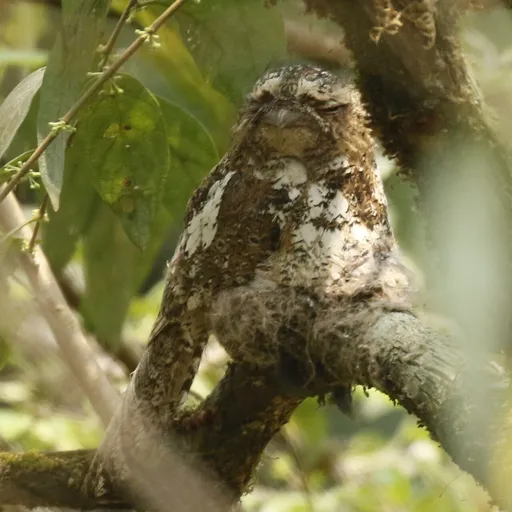
Hodgson's Frogmouth
Batrachostomus hodgsoni
Least Concern
Overview
Batrachostomus hodgsoni is a species of bird in the family Podargidae, found across parts of South and Southeast Asia. As a member of the frogmouth family, it is nocturnal and exclusively arboreal, possessing heavy bills and short, rounded wings that distinguish it from its nightjar relatives.
Identification
- One of the smaller members of its family, measuring 24.5 to 27.5 cm in length and weighing approximately 50 grams.
- Plumage is mottled brown and grey, soft and cryptic, resembling tree bark; males are rufous brown with heavy black and whitish markings, while females are more uniformly rufous.
- Distinguishable by a large head and thick black bill that occupies most of the face, giving the appearance of an "angry old man," along with large yellow-rounded eyes and small legs that prevent walking.
- Often best identified by its call, ranging from soft wheezy whistles to harsh tremulous rattles, with notes such as "whaaee" and "whaaow."
Habitat
This arboreal species inhabits temperate and tropical forests, specifically the middle and lower storeys of evergreen or mixed coniferous tropical rainforests. Its range spans tropical regions of Asia, including Bangladesh, Bhutan, China, India, Laos, Myanmar, Thailand, Cambodia, and Vietnam, at altitudes ranging from 300 to 1,900 metres. The population is non-migratory and generally solitary, with social interactions primarily occurring during the breeding season.
Diet
Hodgson's frogmouth maintains a mainly insectivorous diet, consisting largely of moths, beetles, and other large insects. It forages by catching prey on short flights from perches using a shrike-like or roller-like method, as its short, rounded wings prevent hawking for insects on the wing. It also uses its large, strong bill to dig for insects inside trunks or living tree branches.
Did you know?
The common name is thought to commemorate the British naturalist Brian Houghton Hodgson. To evade predators, the bird employs a "broken branch" camouflage technique where it freezes on a nest with its bill pointed upward, blending its body and beak into the shape of a tree.
Sources
- Wikipedia · CC BY-SA 4.0
- Wikidata · CC0 1.0