
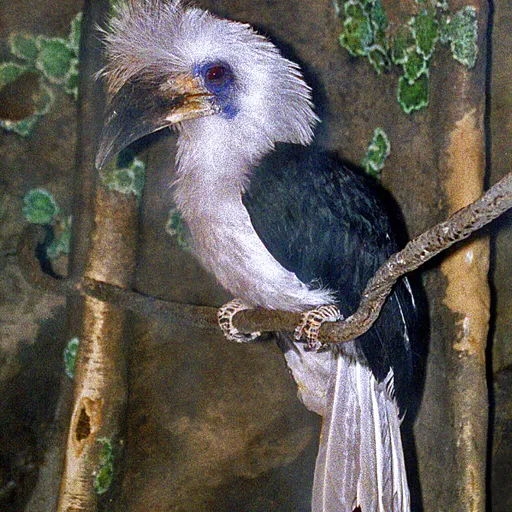
White-crowned Hornbill
Berenicornis comatus
Endangered
Overview
The white-crowned hornbill, also known as the long-crested or white-crested hornbill, is a large species of hornbill found in Southeast Asia. Currently classified as Endangered on the IUCN Red List, this bird is threatened by the significant decline of its forest habitat.
Identification
- A large hornbill measuring 83–102 cm in length and weighing 1.3–1.5 kg, with females being smaller than males.
- Plumage is predominantly black and white, featuring white head, neck, breast and tail feathers, and a black body, with a distinctive white crest of erected crown feathers.
- The bill is mainly black with a yellowish base and includes a blackish casque, while the skin between the eye and bill and on the throat is bare dark blue.
- Females are distinguished from males by having a black neck and underparts.
Habitat
This species inhabits rainforests at low and medium altitudes, typically below 900 meters, and may also be found in fruit, oil-palm and rubber plantations. Its range covers the Malay Peninsula, Sumatra and Borneo.
Diet
These territorial birds feed on a varied diet that includes fruits, lizards, arthropods and larvae.
Did you know?
The breeding female lays two eggs in a tree hole and seals herself inside by blocking the entrance with droppings, debris and mud, relying on the male and other cooperative group members to feed her and the chicks through a narrow opening until the chicks can fly.
Sources
- Wikipedia · CC BY-SA 4.0
- Wikidata · CC0 1.0