
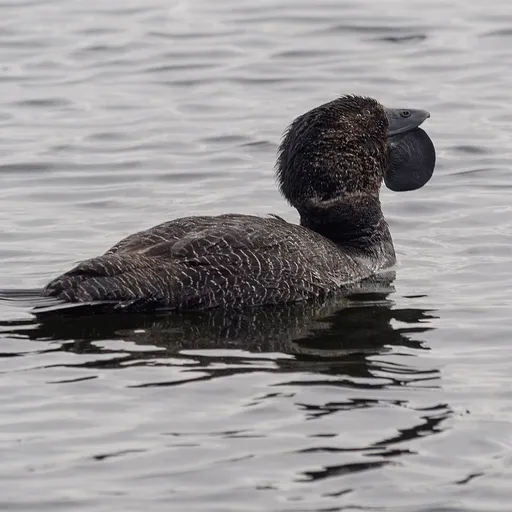
Musk Duck
Biziura lobata
Least Concern
Listen
XC1072525 · Rob Nicholson · Lake Joondalup, Western Australia, Australia · CC BY 4.0
Overview
The musk duck is a highly aquatic, stiff-tailed waterfowl native to southern Australia and the only living member of the genus Biziura. It is the second-heaviest diving duck in the world, with males slightly exceeding the weight of male common eiders. The species is characterised by its inconspicuous appearance and a distinctive musky odour emitted during the breeding season.
Identification
- Size and Build: Moderately large and robust; males measure 60–70 cm and females 47–55 cm, with males averaging over 2.4 kg.
- Plumage: Drab dark grey-brown, slightly pin-striped feathers that are inconspicuous and similar in both sexes, making them hard to distinguish from freckled ducks at a distance.
- Bill: Males possess a distinctive large, leathery lobe on the underside of the bill that swells during breeding; females lack this feature.
- Tail: Features a distinctive fanned tail, which helps distinguish it from similar-looking species like the freckled duck.
Habitat
Musk ducks favour deep, still lakes and wetlands that offer a mix of open water and reed beds. They are found throughout the Murray-Darling and Cooper Creek basins, as well as in the fertile wet areas of southwestern Western Australia, Victoria, and Tasmania. This species is divided into two subspecies: the eastern musk duck, ranging from South Australia to Tasmania, and the western musk duck, found in the south-west of Western Australia.
Diet
Primarily a carnivorous diver, the musk duck feeds on aquatic invertebrates such as water beetles, yabbies, freshwater snails, and shellfish, while also consuming various aquatic plants and occasional fish. It forages by slipping head-first beneath the surface, diving to depths of at least 6 m to search for food in deep water. After feeding, it often submerges again, resurfacing only briefly to breathe before diving back down.
Did you know?
A 1987 recording of a duck named 'Ripper' at Tidbinbilla Nature Reserve, rediscovered in 2021, appears to be the first documented case of a duck species mimicking human speech, capturing the bird saying 'you bloody fool'.
Sources
- Wikipedia · CC BY-SA 4.0
- Wikidata · CC0 1.0