
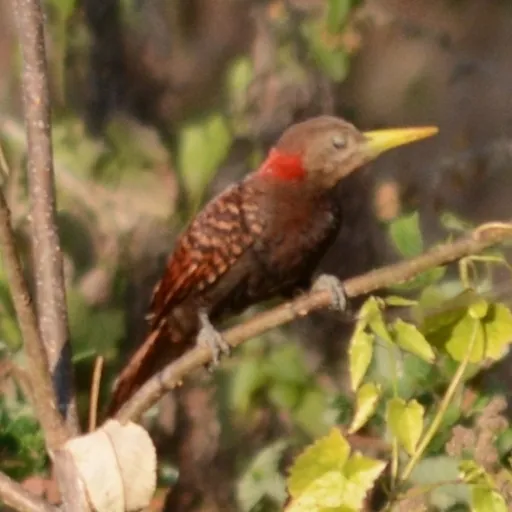
Bay Woodpecker
Blythipicus pyrrhotis
Least Concern
Overview
The bay woodpecker, or Blythipicus pyrrhotis, is a mid-sized species of bird in the family Picidae. It is classified as Least Concern by the IUCN Red List, though its population is generally uncommon and currently on the decline due to habitat loss.
Identification
- Mid-size bird with a body length of 26.5–30 cm and a weight of 126–170 g.
- Males feature a brown crown, a short streaked crest and nape, and a pale brown forehead.
- Females possess a shorter bill than males, a pale head without red on the neck, and lack the brown crown seen in males.
- Vocalisations include a long, dry rattle used for mate contact, and a territorial announcement audible over large distances.
Habitat
Found across South and Southeast Asia, including Bangladesh, Bhutan, China, India, and Vietnam, this species inhabits subtropical or tropical moist lowland and montane forests. They typically reside in heavily wooded ravines with dense growth, living in evergreen and mixed deciduous forests at altitudes ranging from 50 m to 2750 m.
Diet
Their diet consists primarily of insects such as ants, termites, and wood-boring beetles, with occasional consumption of berries. Foraging occurs 3–4 m below the surface level on trunks, rotting snags, logs, saplings, vines, and bamboo. They avoid foraging near other bay woodpeckers but maintain loose contact with their partners.
Did you know?
Bay woodpeckers use specific displays such as crest-raising and wing-flicking when calling for a mate. Both sexes participate in digging the nest hole, which is placed low down between 1–4 m in live or dead wood.
Sources
- Wikipedia · CC BY-SA 4.0
- Wikidata · CC0 1.0