
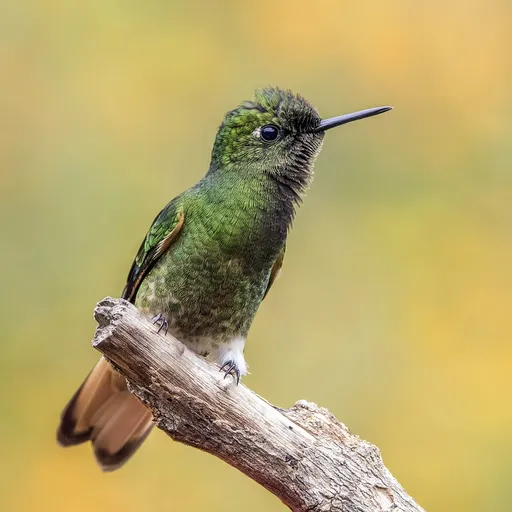
Buff-tailed Coronet
Boissonneaua flavescens
Least Concern
Overview
The buff-tailed coronet, or Boissonneaua flavescens, is a species of hummingbird belonging to the 'Brilliants' tribe. It is a sedentary bird found in the high-altitude forests of northern South America, classified as Least Concern on the IUCN Red List.
Identification
- Measures 11 to 12 cm in length and weighs between 7.3 and 8.8 g, featuring a short, straight, black bill.
- Possesses a small white spot behind the eye and small white tufts on the legs.
- Males of the nominate subspecies are mostly shining green with a buff belly accented by green spots, while underwing coverts are cinnamon and tail feathers are bronze-tipped buff.
- Song consists of a continuous series of single high-pitched 'tsit' notes, sometimes accompanied by squeaky twittering, rising piping notes, and stuttering rattles.
Habitat
Inhabits the interior and edges of humid to wet montane forest, cloudforest, elfin forest, and more open shrubby landscapes in the Andes of western Venezuela, Colombia, and central Ecuador. The species ranges in elevation from 2,000 to 3,500 m, with the nominate subspecies spanning the Andean ranges of Venezuela and Colombia, and B. f. tinochlora occurring in southwestern Colombia and central Ecuador.
Diet
Feeds primarily on nectar from genera such as Cavendishia, Palicourea, Disterigma, and Huilaea, clinging to flowers and holding its wings open briefly after landing. It also captures small insects by hawking from a perch, typically foraging in the mid-story but occasionally in the canopy.
Did you know?
The bird constructs a cup-shaped nest from moss and lichen, usually attaching it to a branch situated between 3 and 10 m above the ground. Breeding behaviour has been recorded between November and March, with the female solely responsible for incubating a clutch of two eggs.
Sources
- Wikipedia · CC BY-SA 4.0
- Wikidata · CC0 1.0