
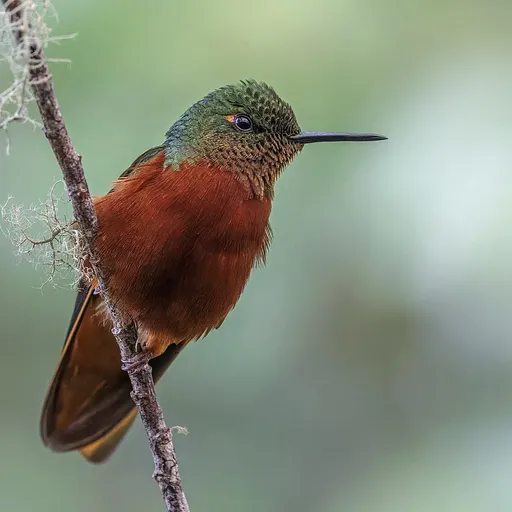
Chestnut-breasted Coronet
Boissonneaua matthewsii
Least Concern
Listen
XC250542 · Niels Krabbe · Zamora-Chinchipe: Reserva Tapichalaca, Ecuador · CC BY-SA 4.0
Overview
The chestnut-breasted coronet, Boissonneaua matthewsii, is a species of hummingbird in the brilliants tribe Heliantheini. It is distributed across the Andes of Colombia, Ecuador, and Peru, where it is assessed as Least Concern on the IUCN Red List.
Identification
- Males exhibit metallic green upperparts, while the throat features yellowish green speckles on a buff base and the remaining underparts are reddish chestnut with green speckles on the flanks.
- Both sexes possess a short, straight, black bill, a distinctive white spot behind the eye, and a notched tail.
- Females are nearly identical to males but display somewhat paler underparts and reduced speckling on the throat.
- Vocalisations consist of a high, thin, liquid tip, a rapid, sweet trill, and various squeaky notes.
Habitat
Found from extreme southeastern Colombia south along the Andes east slope through Ecuador and Peru to Cuzco, as well as on the west slope from central Ecuador to northwestern Peru. The species inhabits the interior and edges of humid montane forest and adjacent gardens. It typically occurs at elevations between 1,500 and 3,300 m, though it is most numerous between 1,900 and 2,700 m in Ecuador.
Diet
Feeds on nectar by clinging to flowers and capturing small insects by hawking from a perch. It forages from the mid-story to the canopy and is highly territorial, defending clusters of flowers from other nectar-feeding birds.
Did you know?
The bird's movements, if any, and breeding phenology have not been documented, leading researchers to assume it makes a cup nest similar to other closely related hummingbirds.
Sources
- Wikipedia · CC BY-SA 4.0
- Wikidata · CC0 1.0