
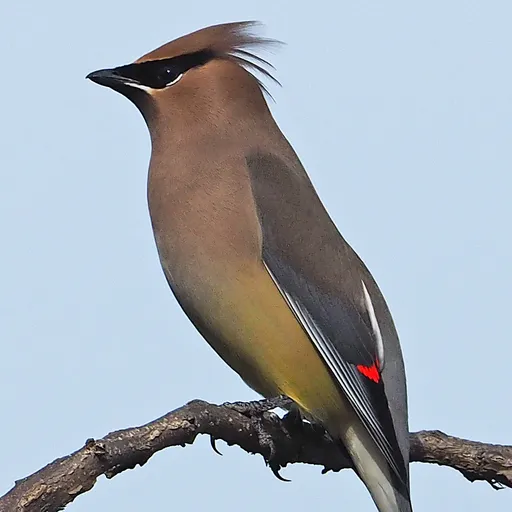
Cedar Waxwing
Bombycilla cedrorum
Least Concern
Listen
XC799645 · steve · Durham, Orange County, North Carolina, United States · CC BY-SA 4.0
Overview
The cedar waxwing (Bombycilla cedrorum) is a medium-sized passerine bird native to North and Central America, characterised by a silky plumage of brown, gray, and yellow. It is a highly sociable species known for its nomadic and irruptive movements across its range.
Identification
- Medium-sized, measuring 6–7 in (15–18 cm) in length with a wingspan of 8.7 to 11.8 in (22 to 30 cm).
- Distinctive features include a subdued crest, a rakish black mask with a thin white border, and brilliant red wax-like droplets on the tips of secondary wing feathers.
- Possesses a short and wide bill; the tail is short, square-tipped, and typically yellow or orange.
- Vocalisations consist of high-pitched whistles and buzzy trills lasting about half a second, often represented as 'see' or 'sree'.
Habitat
Native to North and Central America, breeding in open wooded areas in southern Canada and wintering in the southern United States, Central America, and far northwest South America. Preferred habitats include forest edges, fruiting trees, and urban parklands with well-spaced trees and access to water. Populations are generally increasing due to the expansion of shrublands and the planting of fruiting trees.
Diet
Primarily frugivorous, consuming berries and sugary fruits such as dogwood, serviceberry, cedar cones, and holly year-round, while insects become important during the breeding season. They eat berries whole and may form beak-to-beak chains to share food on twigs. Their diet occasionally includes fermented fruit, which can cause intoxication.
Did you know?
In large flocks, when a berry supply on a twig can only be accessed by one bird at a time, cedar waxwings may line up and pass the berries beak-to-beak down the line so that every individual gets a chance to eat.
Sources
- Wikipedia · CC BY-SA 4.0
- Wikidata · CC0 1.0