
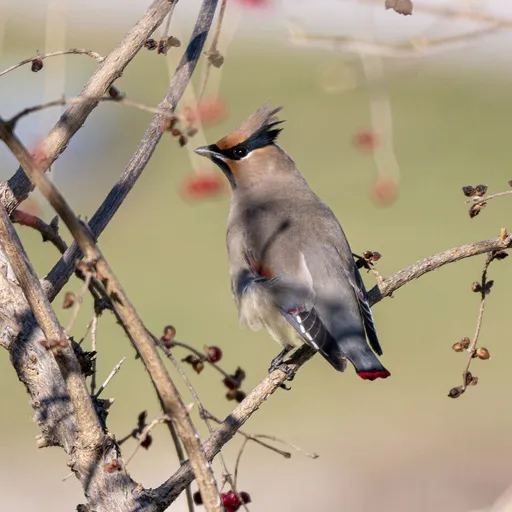
Japanese Waxwing
Bombycilla japonica
Near Threatened
Overview
The Japanese waxwing (Bombycilla japonica) is a fairly small passerine bird in the waxwing family found in the eastern Palaearctic. It is listed as Near Threatened by the IUCN due to the loss and degradation of its preferred forest habitat.
Identification
- Length of 15–18 cm with a weight of 54–64 g, featuring a plumage that is mostly pinkish-brown.
- Characterised by a pointed crest, a black throat, a black stripe through the eye, a pale yellow centre to the belly, a grey rump, and rusty-red undertail coverts.
- A dark grey tail with a black-bordered red tip, and wings with a pattern of black, grey, and white featuring a diffuse reddish-brown bar across the greater covert feathers.
- Males possess red tips on the secondary wing feathers, resembling sealing wax, which gives the species its common name; this feature is absent in females.
- Call is a high-pitched trill, but the species has no true song.
Habitat
Breeds in dense coniferous forests in the Russian Far East (Amur basin, northern Primorsky Krai, and Sakhalin) and northeasternmost China (Manchuria, Heilongjiang province). In winter, it migrates south to open woodland, low-lying farmland, or low mountains in Japan, the Korean Peninsula, eastern China, and Taiwan, often visiting berry-laden trees in parks and private gardens.
Diet
Feeds mainly on fruit and berries, with foraging locations shifting in search of seasonal berries, but also consumes insects during the summer.
Did you know?
The common name 'waxwing' derives from the resemblance of the red tips on the secondary wing feathers to sealing wax, a feature that in this species is present only in males.
Sources
- Wikipedia · CC BY-SA 4.0
- Wikidata · CC0 1.0