
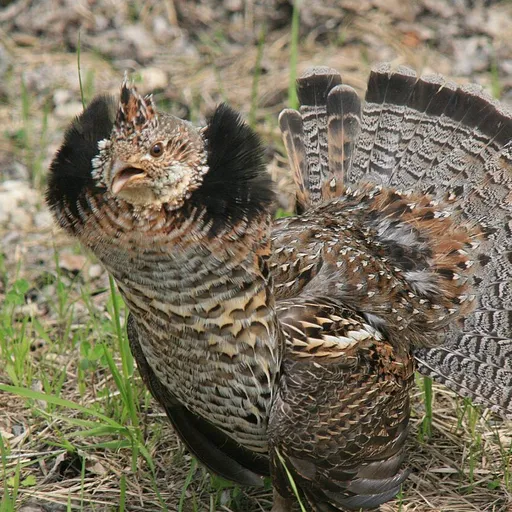
Ruffed Grouse
Bonasa umbellus
Least Concern
Overview
The ruffed grouse (Bonasa umbellus) is a medium-sized, non-migratory bird classified as Least Concern by the IUCN. It is the most widely distributed game bird in North America and the sole species within its genus. Although often misidentified as a partridge or pheasant, it is distinct from these unrelated birds found in open areas.
Identification
- Chunky, medium-sized body measuring 40–50 cm in length with a wingspan of 50–64 cm and a weight of 450–750 g.
- Two distinct plumage morphs exist: a grey-brown morph with light, barred underparts and a brown morph that appears more uniform with a conspicuously grey tail.
- Characterised by neck ruffs in both sexes, a sometimes flat head crest, and a broad black subterminal band on the tail; males typically have unbroken tail bands while females often have broken bands.
- Produces a rapid, non-vocal drumming display by beating wings against the air to create a vacuum, producing a low-frequency sound audible up to 400 m away.
Habitat
This species inhabits forests across a vast range, extending from the Appalachian Mountains through Canada to Alaska. It prefers mixed woodland environments rich in aspen and is the official state game bird of Pennsylvania.
Diet
As an omnivore, the ruffed grouse forages on the ground and in trees, consuming a wide variety of items including buds, leaves, berries, seeds, and insects. Their diet is remarkably diverse, with records of individuals eating live salamanders and small snakes.
Did you know?
Ruffed grouse can burrow into the snow for warmth during winter and may suddenly burst out of the snow cover when approached too closely. They are also known by local nicknames such as 'drummer' or 'thunder-chicken'.
Sources
- Wikipedia · CC BY-SA 4.0
- Wikidata · CC0 1.0