
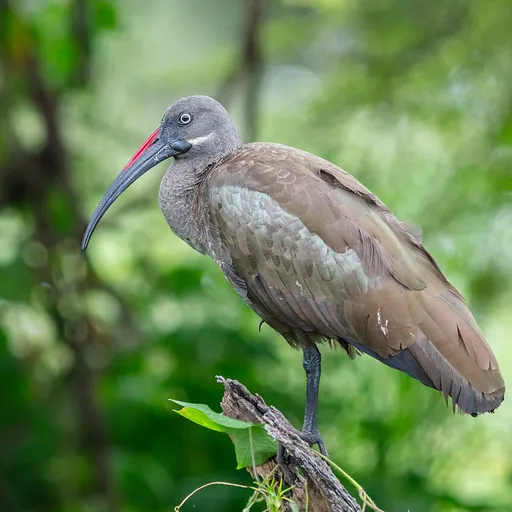
Hadada Ibis
Bostrychia hagedash
Least Concern
Listen
XC1163454 · Frank shirima · Mererani, Simanjiro, Arusha Region, Tanzania · CC BY-SA 4.0
Overview
The hadada ibis, Bostrychia hagedash, is a medium-sized to large ibis native to Sub-Saharan Africa. It is characterised by its grey-to-brown plumage with iridescent wing coverts and is well known for its loud, onomatopoeic calls. This species is non-migratory but often makes nomadic movements in response to rainfall.
Identification
- Approximately 76 cm long with a mean body mass of 1.2 kg, featuring blackish legs and a large, down-curved grey-to-black bill.
- Plumage is grey to partly brown with an iridescent purple or green sheen on the wing coverts, and a narrow white horizontal stripe across the cheeks often referred to as a 'moustache'.
- Possesses an extremely loud and distinctive 'haa-haa-haa-de-dah' call, particularly when flying or startled, while foraging produces a low growl similar to a young puppy.
Habitat
Found throughout Sub-Saharan Africa in open grasslands, savannas, and wetlands, as well as in urban parks, school fields, and large gardens. The species is not highly dependent on water but is frequently found near wetlands and human-altered habitats. Its range in southern Africa has expanded significantly in the 20th century due to increased tree cover and irrigation.
Diet
Feeds on insects, millipedes, earthworms, spiders, small lizards, and snails, using its long bill to probe soft soil. It is particularly valued on golf greens and bowling greens for extracting larvae of moths and beetles that damage grass roots. The bird uses sensory pits near its bill tips to locate unseen subterranean prey.
Did you know?
The hadada ibis can judge the direction of a human's gaze and the speed of their approach to determine escape strategies. In parts of Lesotho, the calls of these birds are considered a sign of impending rain.
Sources
- Wikipedia · CC BY-SA 4.0
- Wikidata · CC0 1.0