
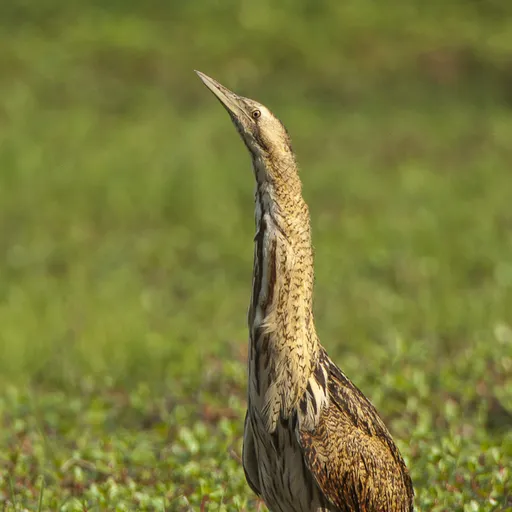
Eurasian Bittern
Botaurus stellaris
Least Concern
Listen
XC1046523 · Sonothèque ADVL · Vains, Manche, Normandie, France · CC0 1.0
Overview
The Eurasian bittern, also known as the great bittern, is a large wading bird belonging to the bittern subfamily of the heron family. It is characterised by its secretive behaviour, often skulking in reed beds and thick vegetation near water bodies. The species comprises two subspecies, with the northern race breeding across the Palearctic and parts of Africa, and the southern race endemic to southern Africa.
Identification
- Plumage: Thickset body with bright, pale, buffy-brown plumage covered in dark streaks and bars; crown and nape are black with long, loosely arranged feathers tipped with buff.
- Size: The largest of the bitterns, measuring 69–81 cm in length with a 100–130 cm wingspan and a mass of 0.87–1.94 kg.
- Head and Neck: Yellowish-buff superciliary stripe and brownish-black moustachial stripe; sides of the neck are rusty-brown with faint barring; throat feathers have longitudinal rusty-brown stripes.
- Voice: The male produces a deep, sighing fog-horn or bull-like boom during the breeding season, audible from up to five kilometres away.
Habitat
The breeding range of the northern subspecies spans temperate Europe and Asia, extending from the British Isles to eastern Siberia, Korea, and Japan, with small resident populations in North Africa. It typically inhabits reed beds, swamps, lakes, lagoons, and sluggish rivers fringed by rank vegetation, preferably in large reed beds of at least 20 hectares. The southern subspecies is found sparingly in marshes near the east coast of southern Africa, the Okavango Delta, and the Drakensberg Mountains.
Diet
The Eurasian bittern feeds on fish, small mammals, birds and their nestlings, snakes, lizards, amphibians, and invertebrates. It forages by walking stealthily or remaining still above shallow water in reed beds, hunting along the reed margins. British records indicate it consumes eels up to 35 cm, mice, voles, frogs, crabs, shrimps, and insects, with some vegetable matter also ingested.
Did you know?
When disturbed, the bittern points its bill directly upwards and freezes, causing its cryptic plumage to blend into the surrounding reeds in a behaviour known as 'bitterning', where the shield of elongated feathers on the throat and breast droop downwards to obscure the outline of the head and body. It also produces a white dusty powder from specialist down feathers at the side of its breast to rid its head and neck of slime after feeding on eels.
Sources
- Wikipedia · CC BY-SA 4.0
- Wikidata · CC0 1.0