
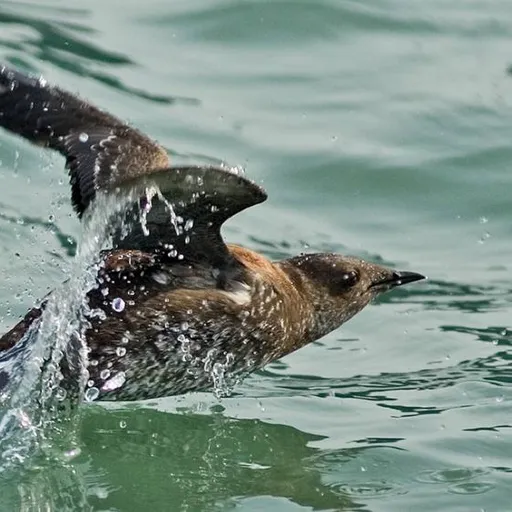
Marbled Murrelet
Brachyramphus marmoratus
Endangered
Overview
The marbled murrelet (Brachyramphus marmoratus) is a small seabird from the North Pacific that is currently classified as endangered. Unlike most alcids, it nests on the branches of old-growth conifers in forests near the coast or on the ground in northern regions. Its population has declined due to habitat loss from logging and other environmental changes.
Identification
- About the size of a partridge (25 cm) with a chunky body and a short, slender, black bill.
- Non-breeding plumage features a white underside, black crown, nape, wings, and back; breeding plumage is brown and mottled.
- Distinguished from the long-billed murrelet by a shorter bill, slightly smaller size, and the presence of a white neck collar in winter plumage.
- Lacks the pale white throat found in breeding long-billed murrelets.
Habitat
Summer range extends from Alaska's Kenai Peninsula and Aleutian Islands south to central California, with wintering occurring mostly within the same general area but avoiding northern sections where ice forms. The species is primarily coastal, typically found within 1.2 miles of saltwater, though it may venture up to 59 miles inland. Nesting sites consist of old-growth forests with large trees, open canopies, and moss-covered limbs, or ground depressions and rock cavities in northern regions where trees are absent.
Diet
Marbled murrelets feed below the water surface on small fish and invertebrates such as sand lance, Pacific herring, capelin, shiner perch, and euphausiids. They forage in pelagic offshore areas, inshore bays, and fiords, and occasionally on inland freshwater lakes. While they often forage in pairs, loose aggregations of up to 500 birds may occur in winter, and feeding takes place both during the day and at night.
Did you know?
Unlike most of its relatives, the marbled murrelet is an arboreal nester, laying a single egg on a platform of lichen or moss on the branches of large conifer trees. Fledglings fly directly from these inland nests to the ocean unaccompanied, relying on their innate instincts to reach the sea.
Sources
- Wikipedia · CC BY-SA 4.0
- Wikidata · CC0 1.0