
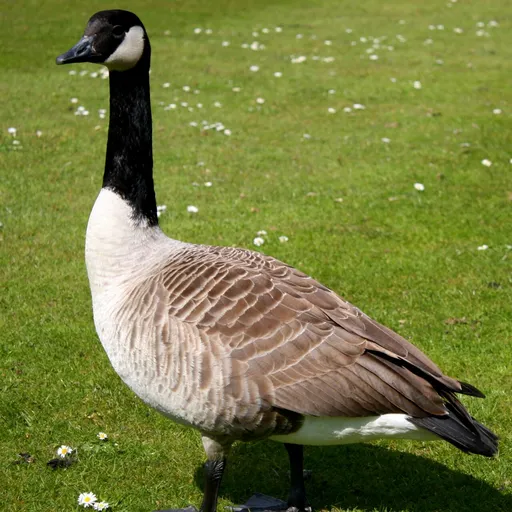
Canada Goose
Branta canadensis
Least Concern
Listen
XC710603 · Christian Kahle · Schneverdingen, Germany · CC0 1.0
Overview
The Canada goose (Branta canadensis) is a large species of goose native to the Arctic and temperate regions of North America, occasionally found during migration in northern Europe. It is characterised by a black head and neck, white cheeks, and a brown body, and is classified as Least Concern on the IUCN Red List. While primarily herbivorous and migratory, many populations have become resident in human-altered areas due to the abundance of food and lack of natural predators.
Identification
- Plumage: Features a distinctive black head and neck with a white 'chinstrap' on the cheeks and under the chin, contrasting with a brown body; some individuals may appear leucistic with pepper-spotted or brown necks.
- Size: Ranges from 75 to 110 cm in length with a wingspan of 127–185 cm, making it the largest living species of 'true goose' (genera Anser and Branta) on average.
- Bill: Length ranges from 4.1 to 6.8 cm.
- Vocalisation: Males produce a loud 'honk', while females produce a shorter, higher-pitched 'hrink' call; when agitated, they may initiate encounters with a high-pitched hiss.
Habitat
Native to North America, this species breeds in Canada and the northern United States in a wide range of habitats, including the Great Lakes region, and lives year-round in the southern part of its breeding range, such as the eastern seaboard and Pacific Coast. It is often found on or close to fresh water, as well as in brackish marshes, estuaries, and lagoons. In recent years, populations have expanded into urban and cultivated habitats like golf courses, public parks, and beaches, where they have established permanent breeding colonies.
Diet
Primarily herbivorous, the Canada goose feeds on green vegetation, including a variety of grasses, beans, and grains such as wheat, rice, and corn. It forages on land by grasping a blade of grass with its bill and tearing it with a jerk of the head, and in water by feeding from aquatic plants. Although mainly plant-based, its diet occasionally includes small insects and fish.
Did you know?
An exceptionally large male giant Canada goose (B. c. maxima) weighed 10.9 kg and had a wingspan of 2.24 m, recorded as the largest wild goose of any species. A single documented case of interspecific killing involved a Canada goose defending its nest against a brant by pecking the intruder's head into the mud for one hour, causing suffocation or drowning.
Sources
- Wikipedia · CC BY-SA 4.0
- Wikidata · CC0 1.0