
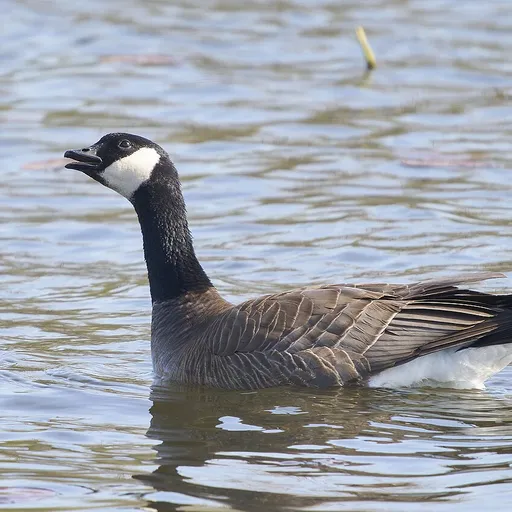
Cackling Goose
Branta hutchinsii
Least Concern
Overview
The cackling goose is a species of goose native to North America and East Asia, previously considered a subspecies of the Canada goose. It was officially split into a distinct species by major ornithological unions in the mid-2000s. The species is listed as Least Concern on the IUCN Red List, though some local populations remain vulnerable.
Identification
- Plumage: Black head and neck with a distinctive white 'chinstrap' marking.
- Size: Varies significantly by subspecies, ranging from 1.4 kg for the smallest (B. h. minima) to up to 3 kg for B. h. hutchinsii.
- Comparison: Distinguished from the similar barnacle goose by its brownish body plumage, as opposed to the barnacle goose's black breast and grey body.
- Vocalisation: The female possesses a different voice from the male, though both may appear virtually identical in plumage.
Habitat
The cackling goose breeds in Northern Canada and Alaska within various tundra habitats, where nests are typically placed on the ground in elevated areas near water. Their overwintering range encompasses most of the United States, with local populations in western Canada, the US West Coast, and northern Mexico. Vagrant birds have reached western Europe, and the species is naturally found in parts of Far Eastern Russia, East China, and Japan.
Diet
These birds feed primarily on plant material, submerging their heads and necks to reach aquatic plants, sometimes tipping forward in a manner similar to dabbling ducks. Flocks frequently feed on leftover cultivated grains in fields, particularly during migration or winter. They also consume a smaller amount of insects, molluscs, and crustaceans.
Did you know?
Nesting pairs can be extremely aggressive, with both geese, especially the male, defending their nesting sites by chasing away people who walk by. This defensive behaviour is a direct response to the vulnerability of ground-level nests to predation by mammals and other animals.
Sources
- Wikipedia · CC BY-SA 4.0
- Wikidata · CC0 1.0