
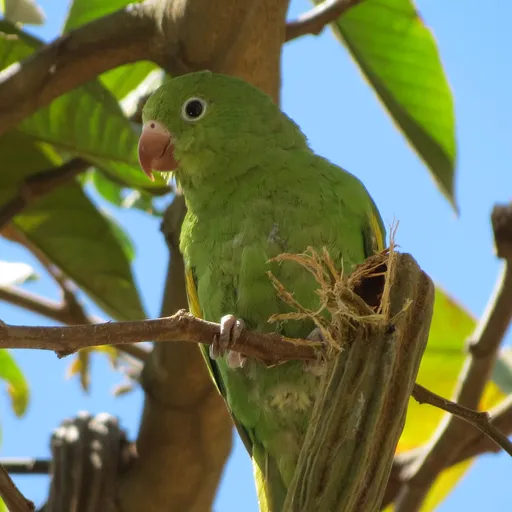
Yellow-chevroned Parakeet
Brotogeris chiriri
Least Concern
Listen
XC957839 · steve · Woodlawn Cemetery, United States · CC BY-SA 4.0
Overview
The yellow-chevroned parakeet (Brotogeris chiriri) is a small parrot native to tropical South America south of the Amazon basin. It has established feral populations in parts of North America and South America, where it appears to be thriving better than the closely related white-winged parakeet.
Identification
- Length of 20–25 cm with light green plumage.
- Distinct trailing yellow edge on the folded wings, visible also in flight.
- Primarily uses disturbed forests and clearings rather than deep tropical forests.
Habitat
Native to tropical South America south of the Amazon River basin, ranging from central Brazil to southern Bolivia, Paraguay, and northern Argentina. The species utilises disturbed forests and forest clearings around settlements, while rarely occupying deep tropical forests. Feral populations are established in Miami and Los Angeles in the United States, as well as in Rio de Janeiro and Buenos Aires.
Diet
Feeds mostly on seeds and fruit in its native habitat, with a preference for Bombacaceae trees, known as silk cotton trees. During dry periods, the bird shifts to consuming more seeds, particularly from Erythrina dominguezii. Feral populations also eat blossoms, nectar, and visit bird feeders, while all populations engage in geophagia by ingesting soil and termite nests to obtain macronutrients such as potassium, magnesium, and aluminium.
Did you know?
These parakeets deliberately consume arboreal termite nests made of clay and organic matter, which provide macronutrients that may assist in egg formation during the breeding season. They also form large communal roosts after raising their young until the next breeding season.
Sources
- Wikipedia · CC BY-SA 4.0
- Wikidata · CC0 1.0