
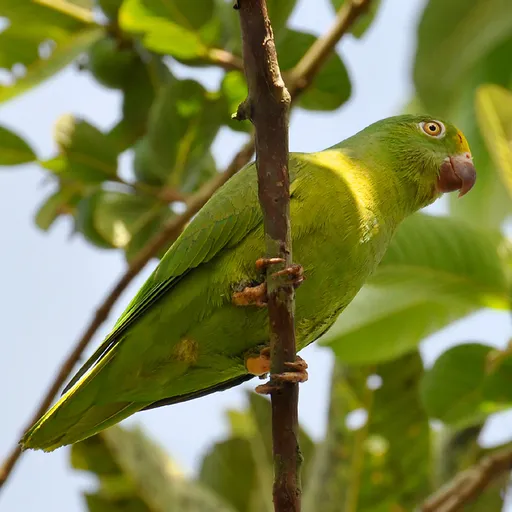
Tui Parakeet
Brotogeris sanctithomae
Least Concern
Overview
The tui parakeet (Brotogeris sanctithomae) is a species of bird in the family Psittacidae, comprising African and New World parrots. It is classified as Least Concern by the IUCN, with a stable population and large range.
Identification
- Adults are 17 to 19 cm long and weigh an average of 59 g, featuring mostly green plumage that is yellower on the rump and underparts.
- The head displays yellow lores and forehead with a bluish tinge on the face, while the primaries are a darker green than the body and bluish on their underside.
- The bill is brown, and subspecies B. s. takatsukasae is distinguished by a yellow streak behind the eye.
- Vocalisations include a high-pitched "klee", shrill "chree" or bisyllabic "chree-chree", and a fast chattering series "cra-cra-cra-cra-cra", often produced simultaneously by flock members.
Habitat
Found in the Amazon Basin across extreme southeastern Colombia, eastern Peru, northern Bolivia, and Brazil east to the Rio Madeira, with possible presence in eastern Ecuador. The species predominantly inhabits semi-open landscapes such as secondary forest, grasslands with some woodlands, riverbanks, islands with dense scrub, and the edges of várzea forest.
Diet
The tui parakeet feeds on fruit and blossoms from a variety of plants, including palms. It also forages in manioc and sugarcane plantations.
Did you know?
Nest cavities in arboreal termite nests have been documented for this species. One observed nest contained six nestlings, though typical clutch sizes and incubation periods remain unknown.
Sources
- Wikipedia · CC BY-SA 4.0
- Wikidata · CC0 1.0