
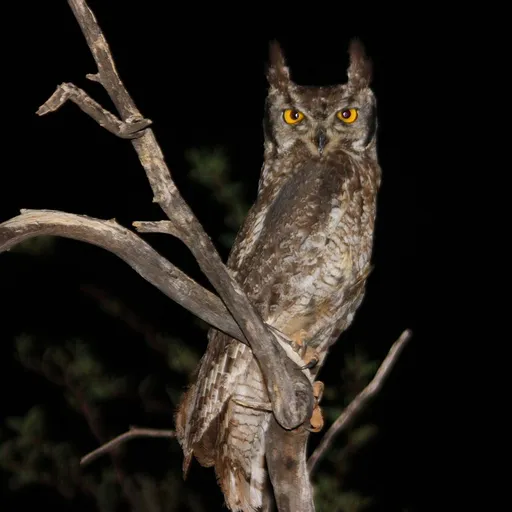
Spotted Eagle-Owl
Bubo africanus
Least Concern
Overview
The spotted eagle-owl (Bubo africanus), also known as the African spotted eagle-owl, is a medium-sized species and one of the smallest of the eagle owls. It is the most common owl species in Southern Africa and is classified as Least Concern on the IUCN Red List.
Identification
- Length of 45 cm with a wingspan of 100 to 140 cm, and a weight ranging from 454 to 907 grams.
- Dusky brown upper body with off-white underparts marked by brown bars.
- Off-white to pale ochre facial disk, yellow eyes, and prominent ear-tufts.
- Distinctive calls include a two-hoot call from the male and a three-hoot response from the female.
Habitat
This species occurs throughout Sub-Saharan Africa and the Arabian Peninsula, favouring rocky areas and open spaces for roosting. It is highly adaptable to human environments, often living in close proximity to habitation and referred to as an urban owl, with populations found in suburban gardens and on man-made structures.
Diet
A generalist feeder, the spotted eagle-owl primarily consumes rodents, small mammals, birds, insects, arthropods, reptiles, frogs, and carrion. It typically swallows prey whole, exhibiting head-jerking and pausing during the process, and regurgitates undigested parts as pellets within 24 hours. The bird is itinerant, moving when local prey becomes scarce, and adult pairs aggressively defend their hunting territories.
Did you know?
Young spotted eagle-owls, when alarmed, hiss and snap their beaks castanet-like while spreading their wings sideways in an umbrella-like display to present their upper surfaces forward. Additionally, in extreme cases of starvation, males have been observed tearing the head off a mouse but bringing the body to the female to feed the young or herself.
Sources
- Wikipedia · CC BY-SA 4.0
- Wikidata · CC0 1.0