
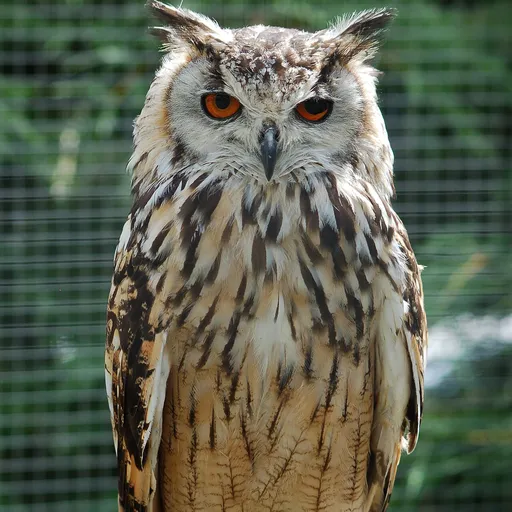
Indian Eagle-Owl
Bubo bengalensis
Least Concern
Listen
XC878419 · Jairam Vijayan · Payyavoor, Kannur, Kerala, India · CC BY-SA 4.0
Overview
The Indian eagle-owl, also known as the Bengal eagle-owl or rock eagle-owl, is a large horned owl species native to the Indian subcontinent. It is currently classified as Least Concern on the IUCN Red List.
Identification
- Splashed brown and grey plumage with a white throat patch marked by small black stripes.
- Unmarked facial disk with a distinct black border.
- Rufous base to the primaries with wider tawny bands than black ones on the tail.
- A large pale scapular patch is visible on the folded wing.
- Deep resonant booming call, often heard at dawn and dusk.
Habitat
This species inhabits hilly and rocky scrub forests in the Indian subcontinent, typically found south of the Himalayas below 1,500 m elevation. Favourite haunts include bush-covered rocky hillocks, ravines, and steep river banks, while humid evergreen forests and extremely arid areas are avoided.
Diet
Rodents constitute the primary diet throughout most of the year, though birds are taken more frequently towards winter. Prey species include francolins, doves, crows, and occasionally flying foxes, with rodents typically torn up rather than swallowed whole.
Did you know?
In some cultures, it is believed that if the owl is starved for a few days and beaten, it will speak like a human to predict the future or bring wealth to the tormentor. Another superstition holds that a lucky bone, capable of moving against the current like a snake when dropped in a stream, can be found in the bird's carcass.
Sources
- Wikipedia · CC BY-SA 4.0
- Wikidata · CC0 1.0