
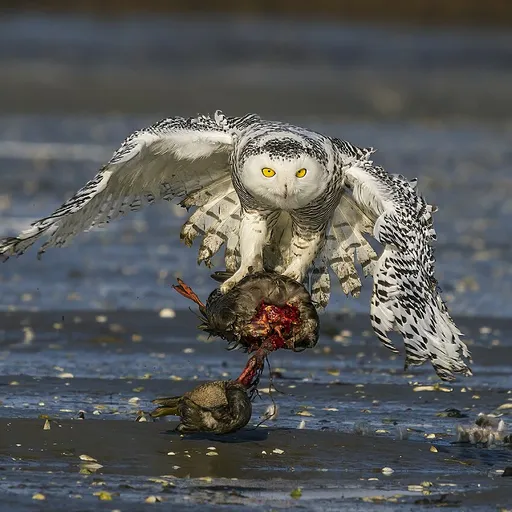
Snowy Owl
Bubo scandiacus
Vulnerable
Overview
The Bubo scandiacus, also known as the polar or Arctic owl, is one of the largest owl species and the only one with predominantly white plumage. It is a nomadic bird native to the Arctic regions of North America and the Palearctic, listed as Vulnerable on the IUCN Red List.
Identification
- Males are typically purer white, while females are dusky and more heavily flecked or barred with dark brown.
- Bright yellow eyes with a relatively small head and shallow facial disc; ear tufts are usually absent but can be erected.
- Extremely thickly feathered white toes and black claws; no black wingtips, unlike many other white birds.
- Steady, direct flight reminiscent of a large, slow-flying falcon, though somewhat audible at close range.
Habitat
Native to the Arctic regions of North America and the Palearctic, the snowy owl breeds mostly on the tundra. It is a largely migratory and nomadic bird that can wander close to the Arctic or unpredictably irrupt southwards in large numbers.
Diet
A specialized and generalist hunter, the snowy owl primarily feeds on tundra-dwelling lemmings but adapts to other small mammals, northerly water birds, and carrion. It is active during the day, especially in summer, and may use hovering flight as a hunting method.
Did you know?
The snowy owl possesses the longest toe feathers of any owl, averaging 33.3 mm, which are significantly longer than those of the great horned owl.
Sources
- Wikipedia · CC BY-SA 4.0
- Wikidata · CC0 1.0