
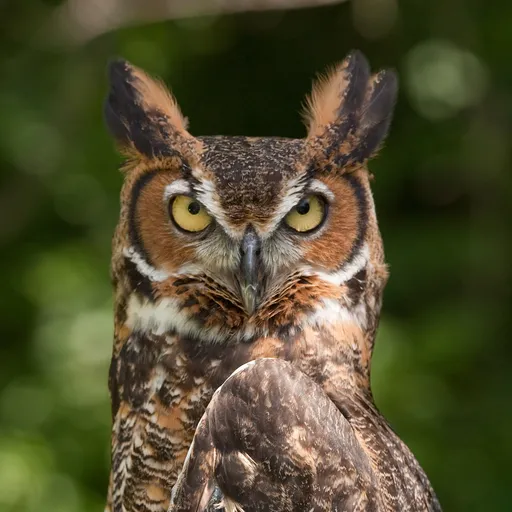
Great Horned Owl
Bubo virginianus
Least Concern
Listen
XC935595 · Doug Hynes · Goulds, Newfoundland and Labrador, Canada · CC BY-SA 4.0
Overview
The great horned owl (Bubo virginianus), also known as the tiger owl, is a large owl native to the Americas that holds the status of Least Concern on the IUCN Red List. It is an extremely adaptable bird and the most widely distributed true owl in the Americas, with a vast range spanning from Alaska to South America.
Identification
- Generally coloured for camouflage, with light underparts featuring brown horizontal barring and mottled brown upper parts.
- Possesses a facial disc in reddish, brown, or grey tones, demarcated by a dark rim and bold, blackish side brackets.
- Bears eyebrow-like 'horns' which are feather tufts called plumicorns.
- Produces a low-pitched, resonant song transcribed as ho-ho-hoo hoo hoo, often described as solemn or terrifying.
Habitat
This species is an extremely adaptable bird with a vast range across the Americas, making it the most widely distributed true owl on the continent. It shares similar habitat, prey, and nesting habits by day with the red-tailed hawk, serving as a nocturnal ecological equivalent to the Eurasian eagle-owl.
Diet
The diet consists primarily of rabbits and hares, rats and mice, and voles, while also including larger mid-sized mammals, birds, reptiles, amphibians, and invertebrates. It remains one of the few regular predators of skunks and is capable of silent flight, allowing it to approach prey without detection.
Did you know?
The talons of a great horned owl can apply at least 300 psi of crushing power, a pressure considerably greater than that exerted by a human hand. In some large females, this gripping power is comparable to that of much larger raptor species, such as the golden eagle.
Sources
- Wikipedia · CC BY-SA 4.0
- Wikidata · CC0 1.0