
Trumpeter Finch
Bucanetes githagineus
Least Concern
Overview
The trumpeter finch (Bucanetes githagineus) is a small passerine bird in the finch family Fringillidae, primarily associated with desert environments. Its range spans from North Africa and Spain through to southern Asia, though it has occasionally occurred as a vagrant in areas north of its breeding grounds.
Identification
- Small, long-winged bird with a large head and a short, very thick bill.
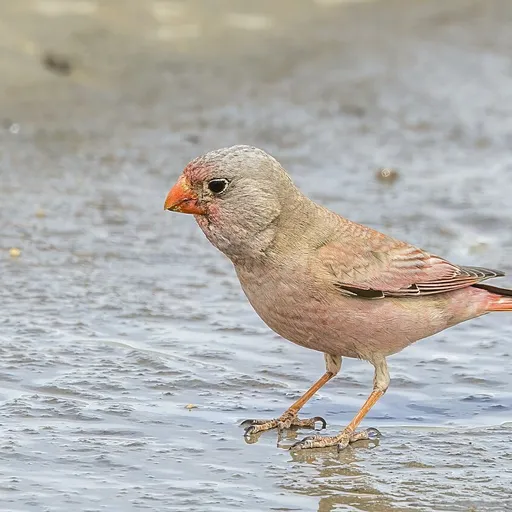
- Summer males possess a red bill, a grey head and neck, and pale brown upper parts, while their breast, rump, and tail are pink.
- Winter males, females, and young birds are a very washed-out version of the breeding male.
- Song is described as a buzzing nasal trill, likened to a tin trumpet.
Habitat
Found in deserts, semi-deserts, and their margins, as well as vast open steppe areas with dry hills, sparse low scrubby vegetation, stony plains, and cliffs. In northern African deserts, the species can also occur in villages, gardens, and oases. In Europe, it inhabits areas with no tree cover but with sparse scrub less than a metre high.
Diet
Mainly vegetarian, the trumpeter finch feeds on the small seeds, shoots, and buds of grasses and low ground-loving plants, supplemented occasionally by insects such as grasshoppers.
Did you know?
The genus name Bucanetes is derived from the Ancient Greek for 'trumpeter', referencing the bird's loud, tin-trumpet-like call, while the specific name githagineus relates to the corn cockle plant.
Sources
- Wikipedia · CC BY-SA 4.0
- Wikidata · CC0 1.0