
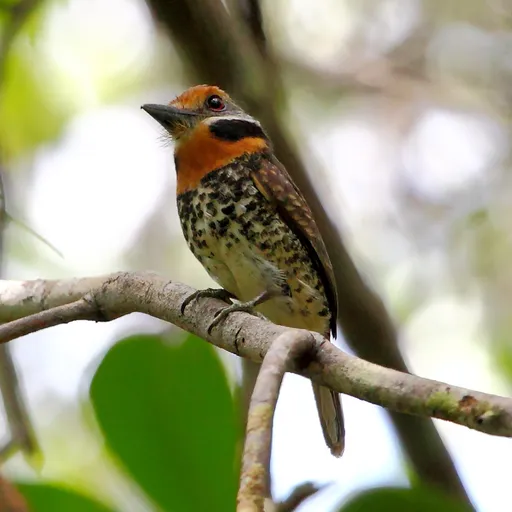
Spotted Puffbird
Bucco tamatia
Overview
The spotted puffbird (Bucco tamatia) is a species of puffbird found across various parts of South America. It inhabits open landscapes such as savanna woodland and gallery forest, typically ranging from sea level to 1,400 m, though usually occurring below 700 m in Venezuela.
Identification
- Approximately 18 cm long with a black bill, bright red eye, and dark gray or greenish feet.
- Upperparts are dark brown with buffy scallops; crown features rufous spots on a dark background, a blackish eye-band, and a white stripe continuing around the nape.
- Underparts include a white chin, rufous throat, and whitish breast with black spots and scales.
- Song consists of 10–20 soft, whistled 'chyoi' or 'puwéep' notes, often sung at dawn or as a duet.
Habitat
Found in Bolivia, Brazil, Colombia, Ecuador, French Guiana, Guyana, Peru, Suriname, and Venezuela, the species inhabits somewhat open landscapes including várzea and igapó forests, mature secondary forest, savanna woodland, and gallery forest. It seldom occurs in the interior of dense forest.
Diet
The spotted puffbird forages from a low perch, sallying out to pluck prey from foliage or bark, and sometimes follows army ant swarms. Its diet consists of many types of insects, invertebrates such as spiders and scorpions, small lizards, and mistletoe berries.
Did you know?
The bird lays its clutch of two eggs in a chamber excavated in arboreal termitaria.