
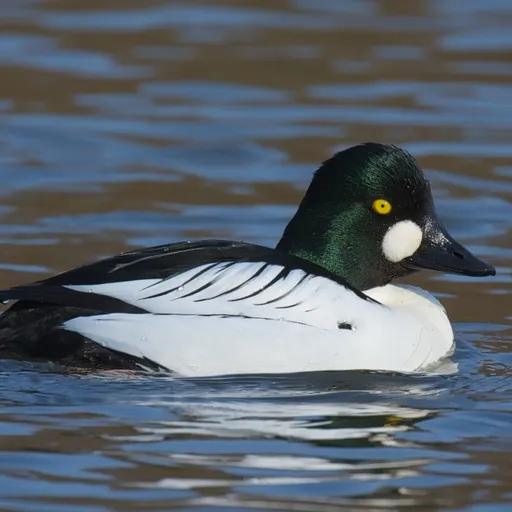
Common Goldeneye
Bucephala clangula
Least Concern
Listen
XC518957 · Pascal Christe · Hagneck, Switzerland · CC BY-SA 4.0
Overview
The common goldeneye (Bucephala clangula) is a medium-sized sea duck and the closest relative of Barrow's goldeneye. This species is characterised by its aggressive territorial behaviour and elaborate courtship displays.
Identification
- Golden-yellow eyes
- Adult males possess a dark head with a greenish gloss and a circular white patch below the eye, paired with a white neck and belly
- Adult females exhibit a brown head and a mostly grey body
- Orange-yellow legs and feet
Habitat
Breeding habitat is the taiga, specifically the lakes and rivers of boreal forests across Canada, the northern United States, Scotland, Scandinavia, the Baltic States, and northern Russia. The birds are migratory, wintering in protected coastal waters or open inland waters at more temperate latitudes. They naturally nest in cavities in large trees or nest boxes.
Diet
Common goldeneyes are diving birds that forage underwater. Their diet consists primarily of crustaceans, aquatic insects, and molluscs, with insects predominating during nesting and crustaceans during migration and winter. Locally, they also consume fish eggs and aquatic plants.
Did you know?
Brood parasitism is quite common among common goldeneyes, where young are often abandoned or mixed with other females' broods as they become independent. Goldeneye young have even been known to be competitively killed by other goldeneye mothers, common loons, and red-necked grebes.
Sources
- Wikipedia · CC BY-SA 4.0
- Wikidata · CC0 1.0