
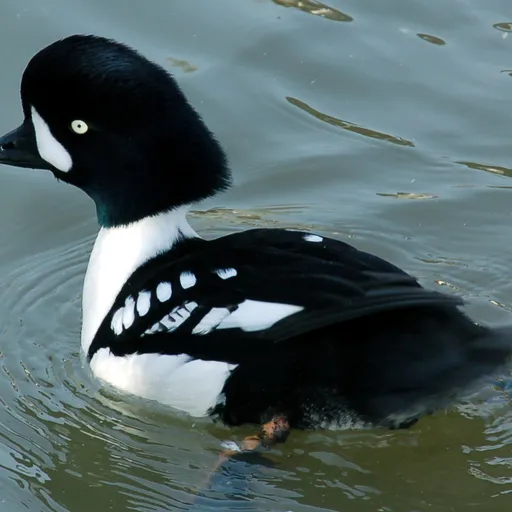
Barrow's Goldeneye
Bucephala islandica
Least Concern
Overview
Barrow's goldeneye (Bucephala islandica) is a medium-sized sea duck of the genus Bucephala, named after Sir John Barrow. Classified as Least Concern on the IUCN Red List, this species is monotypic with no recognised subspecies.
Identification
- Adult males feature a dark head with a purplish gloss and a distinct white crescent at the front of the face, differentiating them from the common goldeneye's round white patches and greenish gloss.
- Females possess a mostly yellow bill, contrasting with the common goldeneye, which has a bill that is yellow only at the tip.
- Males average 49 cm in length and weigh 0.97 kg, while females are typically 43 cm long and weigh 0.59 kg, with a wingspan of 70–73 cm.
- The bird is relatively quiet, producing low-volume squeaks, grunts, and croaks during breeding, while its fast wing movement creates a low whistling sound in flight.
Habitat
Breeding habitat consists primarily of wooded lakes and ponds in northwestern North America, with scattered populations in eastern Canada and Iceland. During winter, the species migrates to protected coastal waters or open inland waters, relying heavily on urbanised coastal estuaries as stopping places. It is an extremely rare vagrant to western Europe, with only three accepted records from Scotland.
Diet
These diving birds forage underwater for aquatic insects, crustaceans, and pond vegetation. Their main dietary staples are the marine crustaceans Gammarus oceanicus and Calliopius laeviusculus, alongside a significant portion of mussels and gastropods.
Did you know?
Barrow's goldeneyes are considered an arboreal bird species because they nest in cavities found in mature trees, though they also use ground burrows or protected sites. Males often remain with their mate through the winter and defend their territory, even when the pair is separated for long periods during the male's molting season.
Sources
- Wikipedia · CC BY-SA 4.0
- Wikidata · CC0 1.0