
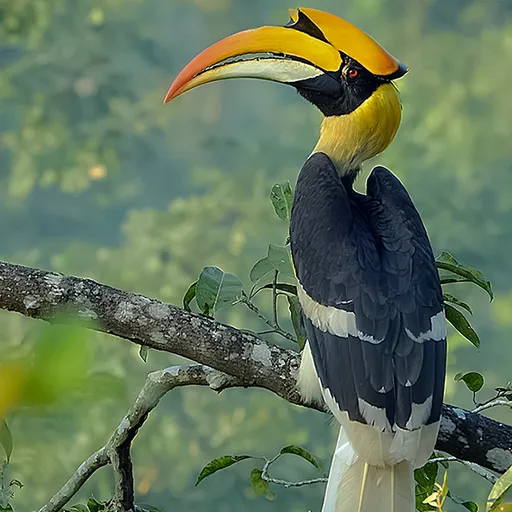
Great Hornbill
Buceros bicornis
Vulnerable
Overview
The great hornbill (Buceros bicornis), also known as the great Indian hornbill, is one of the larger members of the hornbill family. It is the heaviest of all typical hornbills and is currently listed as Vulnerable on the IUCN Red List.
Identification
- A large bird measuring 95–130 cm in length with a 152 cm wingspan and a weight of 2 to 4 kg.
- Characterised by a massive bill topped with a bright yellow and black casque that appears U-shaped from the front with a concave top.
- Males have red eyes while females have bluish-white eyes; both possess prominent 'eyelashes' and pinkish orbital skin.
- Flight involves stiff, heavy wingbeats that produce a sound likened to the puffing of a steam locomotive starting up.
Habitat
Native to the forests of India, Bhutan, Nepal, Mainland Southeast Asia, Sumatra, and Ujung Kulon of Java. The species prefers dense old-growth unlogged forests in hilly regions and appears dependent on large stretches of rain forests.
Diet
Predominantly frugivorous, relying heavily on figs and lipid-rich fruits from families such as Lauraceae and Myristicaceae, while also consuming small mammals, birds, reptiles, amphibians, and large insects. They forage along branches by hopping, tearing up bark, and catching prey that is tossed in the air and swallowed.
Did you know?
The great hornbill can live for nearly 50 years in captivity, yet breeding in captivity is notoriously difficult with fewer than a dozen successful attempts recorded globally.
Sources
- Wikipedia · CC BY-SA 4.0
- Wikidata · CC0 1.0