
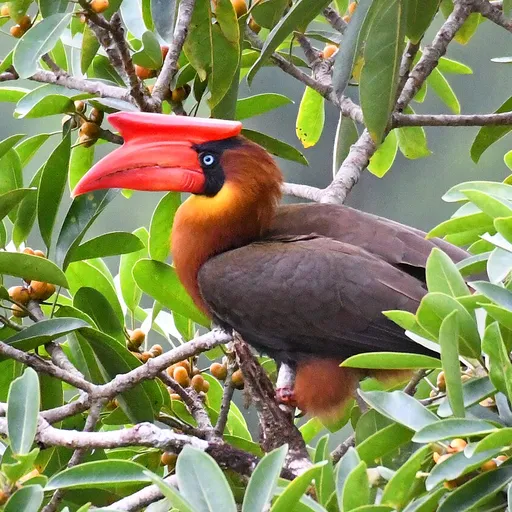
Rufous Hornbill
Buceros hydrocorax
Vulnerable
Overview
The rufous hornbill (Buceros hydrocorax), also known as the Philippine hornbill or kalaw, is a large hornbill species endemic to the Philippines and the largest of its kind in the country. Currently classified as Vulnerable on the IUCN Red List, it is a keystone species that faces significant threats from habitat loss and the illegal pet trade.
Identification
- Large bird with a dark body, rufous legs, chest, and neck, contrasting with an off-white tail and black face.
- Sexes are dimorphic: females possess striking electric blue eyes and a smaller casque, whereas males have yellow eyes and a larger casque.
- The bill of the nominate subspecies is entirely red, caused by the oxidation of oils from the uropygial gland, while subspecies semigaleatus and mindanensis have a pale yellow distal half.
- Known as the "clock of the mountains" due to a loud booming call heard up to 1.5 km away, and distinct whirring wings in flight.
Habitat
Inhabits moist tropical lowland forest areas, including primary evergreen dipterocarp, mature secondary, and disturbed forests. The species is found across the majority of the Philippines, excluding Mimaropa, Sulu, and Western Visayas, with the northern subspecies recorded up to 760 m and the southern subspecies up to 2,100 m above sea level.
Diet
An omnivore and keystone species that consumes fruit, dispersing seeds along the forest floor, and preys on insects to control pest populations.
Did you know?
Females seal themselves inside nesting cavities in large dipterocarp trees 15 to 30 m above the ground, remaining confined with their growing young for the entire 4–6 month nesting period while the male feeds them through a narrow slit.
Sources
- Wikipedia · CC BY-SA 4.0
- Wikidata · CC0 1.0