
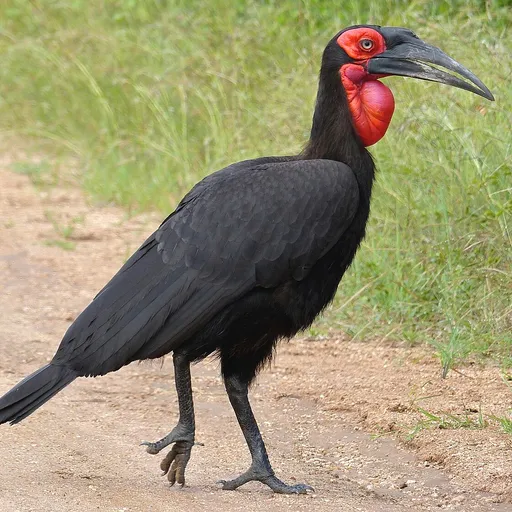
Southern Ground Hornbill
Bucorvus leadbeateri
Vulnerable
Overview
The southern ground hornbill (Bucorvus leadbeateri) is the largest species in the hornbill order, found exclusively in Africa. It is classified as Vulnerable globally, with populations declining due to habitat loss and persecution. These apex predators live in cooperative groups and require vast territories to sustain their slow reproductive rates.
Identification
- Large bird measuring 90 to 129 cm in length, with a wingspan of 1.2 to 1.8 m.
- Predominantly black plumage with vivid red patches of bare skin on the face and throat, though females have violet-blue throats and juveniles have dull grey patches.
- Distinctive white tips on the primary wing feathers visible in flight, along with eyelashes that are rare among birds.
- Loud vocalisations, including choral calls, can be heard from up to 3 km away.
Habitat
Found in the southern regions of Africa, ranging from Kenya to South Africa, Lesotho, Namibia, and Eswatini. They inhabit woodlands and savannas that feature large trees for nesting and dense but short grass for foraging. Their distribution is limited in the west by the lack of suitable nesting trees.
Diet
Carnivorous foragers that hunt primarily on the ground, consuming insects, reptiles, frogs, snails, and mammals up to the size of hares. They rarely drink and rely on moisture from their prey. As apex predators, they occupy a significant ecological niche in their environment.
Did you know?
These birds exhibit siblicide, where only one nestling survives despite clutches of one to three eggs, and they do not reach sexual maturity until 4 to 6 years of age. They are also culturally significant in southern Africa, often associated with death, rain, and weather forecasting by local communities.
Sources
- Wikipedia · CC BY-SA 4.0
- Wikidata · CC0 1.0